Support our educational content for free when you purchase through links on our site. Learn more
The Cursed Tomb of Genghis Khan: 12 Theories & Secrets Revealed 🏹

For nearly 800 years, the final resting place of Genghis Khan has remained one of history’s greatest enigmas—a secret so fiercely guarded that it’s wrapped in legends of curses, mass killings, and sacred taboos. Despite countless expeditions, satellite hunts, and high-tech scans, the tomb’s exact location still eludes archaeologists and adventurers alike. But why has this Mongol emperor’s grave resisted discovery so stubbornly? And could disturbing it really unleash a catastrophic curse?
In this deep dive, we unravel the 12 most compelling theories about where Genghis Khan might be buried—from sacred mountains and secret riverbeds to hidden caves and underwater vaults. Along the way, we explore the cultural reverence that keeps the tomb protected, the modern technology used in the search, and the chilling legends that have kept treasure hunters at bay. Stick around for our expert insights, surprising historical anecdotes, and a sneak peek at the cutting-edge gear explorers use to chase this elusive mystery.
Key Takeaways
- Genghis Khan’s tomb remains undiscovered, largely due to deliberate secrecy, cultural taboos, and the forbidding Mongolian wilderness.
- The Ikh Khorig “Great Taboo” area is a sacred, off-limits zone protecting the burial site, guarded by tradition and law.
- Legends of a deadly curse deter grave robbers and explorers, echoing similar myths like the Curse of Tutankhamun.
- Modern explorers use satellite imagery, drones, and ground-penetrating radar to scan vast regions without disturbing the land.
- There are 12 leading theories on the tomb’s location, including river diversion burial, horse trampling, and hidden caves—each with unique historical backing.
- Respect for Mongolian culture and heritage is paramount; the tomb is as much a spiritual symbol as a historical mystery.
Ready to uncover the secrets behind the world’s most mysterious tomb? Let’s ride into history’s greatest archaeological quest!
Welcome to History Hidden™, where we dig up the past so you don’t have to (and because some things are better left buried!). We are your resident team of history buffs, explorers, and occasional curse-avoiders. Today, we’re diving into one of the greatest mysteries of the archaeological world: the Cursed Tomb of Genghis Khan.
Have you ever wondered how a man who conquered nearly the entire known world could simply… vanish? No gold-plated sarcophagus, no giant pyramid, just a 800-year-old game of hide-and-seek that would make even the most seasoned National Geographic explorer sweat. Is it hidden behind a wall of ancient traps, or is there a supernatural “keep out” sign we should probably respect? Let’s find out. 🐎🏹
Table of Contents
- ⚡️ Quick Tips and Facts
- 🏹 The Rise of the Universal Ruler: A History of the Mongol Empire
- 🚫 The Great Taboo: Why the Ikh Khorig Remains Off-Limits
- 💀 The Legend of the Curse: Why You Shouldn’t Dig Up the Great Khan
- 🛰️ Modern Tech vs. Ancient Secrets: The Search for the Lost Burial Site
- 👑 Inside the Ancient Royal Tomb Found by Accident: Lessons from Other Mongol Burials
- 🌊 Uncovering the Sunken Relics of an Ancient City: Could the Tomb Be Underwater?
- 📸 The Picture That Tells a Lesser-Known Chapter of US History: Why Americans Are Obsessed with the Khan
- 🐱 Why Tonnes of Mummified Cats Ended Up in England: Comparing Burial Rituals Across Cultures
- 📍 12 Theories on Where Genghis Khan is Buried
- 📜 Conclusion
- 🔗 Recommended Links
- ❓ FAQ
- 📚 Reference Links
⚡️ Quick Tips and Facts
Before we mount our horses and head for the steppes, here’s the “too long; didn’t read” version of the Khan’s final resting place:
- The Vanishing Act: Genghis Khan died in 1227 during a campaign against the Western Xia.
- The Body Count: Legend says the funeral escort killed anyone they met on the way to the burial, then the soldiers who buried him were killed, and then the soldiers who killed those soldiers were killed. Talk about a “dead” end job! ✅
- The Location: The most likely spot is Burkhan Khaldun, a sacred mountain in the Khentii Mountains of Mongolia.
- The Curse: Much like the Curse of the Pharaohs, it is said that disturbing the Khan will trigger a world-ending event. ❌ (Don’t test this, please).
- Modern Search: Scientists use satellite imagery and ground-penetrating radar because the Mongolian government strictly forbids traditional digging.
- The “Ikh Khorig”: This translates to the “Great Taboo,” a 240-square-kilometer area that was closed off to everyone but the royal family and the Darkhad (the elite guards) for centuries.
🏹 The Rise of the Universal Ruler: A History of the Mongol Empire

To understand why the cursed tomb of Genghis Khan is such a big deal, we have to look at the man himself. Born Temujin, he didn’t just wake up one day and decide to own 12 million square miles. He fought his way from a poverty-stricken outcast to the “Universal Ruler.”
By the time he died, the Mongol Empire stretched from the Pacific Ocean to the Caspian Sea. We’re talking about a guy who revolutionized postal systems (the Yam), promoted religious tolerance, and—let’s be honest—was responsible for a significant percentage of the modern human gene pool.
When he died in 1227, he didn’t want a monument. He wanted secrecy. He requested to be buried in an unmarked grave in his homeland. This wasn’t just humility; it was a strategic move to ensure his remains were never desecrated by enemies. We think he succeeded a little too well.
🚫 The Great Taboo: Why the Ikh Khorig Remains Off-Limits
For nearly 800 years, a massive region of Mongolia known as the Ikh Khorig was strictly forbidden to outsiders. If you stepped foot there without permission, the punishment was death. Simple, effective, and very Mongol.
Even today, the area is a UNESCO World Heritage site, and while the “death penalty” for trespassing is gone, the cultural “keep out” sign remains. The Mongolian people view Genghis Khan not just as a historical figure, but as a semi-divine ancestor. To them, digging for his tomb isn’t “archaeology”—it’s grave robbing.
We at History Hidden™ respect the hustle, but we also respect the culture. If the locals say “don’t dig,” we probably shouldn’t dig.
💀 The Legend of the Curse: Why You Shouldn’t Dig Up the Great Khan
You’ve heard of the Curse of Tutankhamun, right? Well, the Mongol version is even more intense. The legend states that if Genghis Khan’s tomb is ever opened, the world will end.
If you think that sounds like a movie plot, look at the case of Timur (Tamerlane). In 1941, Soviet anthropologists opened the tomb of the great Mongol-Turkic conqueror Timur in Samarkand. Inside, they allegedly found an inscription: “Whomsoever opens my tomb shall unleash an invader more terrible than I.”
Two days later, Adolf Hitler launched Operation Barbarossa and invaded the Soviet Union. 😱
Coincidence? Maybe. But when it comes to the cursed tomb of Genghis Khan, most people aren’t willing to roll the dice.
🛰️ Modern Tech vs. Ancient Secrets: The Search for the Lost Burial Site
Since we can’t go in with shovels, we have to use the “eyes in the sky.” Dr. Albert Lin, a renowned explorer often featured on National Geographic, led a massive crowdsourcing project to find the tomb.
Using high-resolution satellite imagery, thousands of volunteers scanned the Mongolian landscape for “anomalies.” They looked for:
- Rectangular foundations.
- Man-made rock piles (Ovoos).
- Changes in vegetation that might suggest disturbed earth.
They used Garmin GPS units to mark coordinates and DJI drones to get a closer look. While they found many ancient structures, the big prize—the Khan himself—remains elusive. It’s like the ultimate “Where’s Waldo,” but Waldo is a 13th-century warlord.
👑 Inside the Ancient Royal Tomb Found by Accident: Lessons from Other Mongol Burials
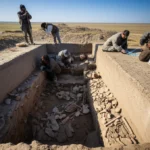
While we haven’t found Genghis, we have found other Mongol elite burials. These give us a clue of what to expect. In 2001, a joint German-Mongolian expedition found a tomb in the Gol Mod area.
Inside, they found:
- Chariots decorated with gold.
- Intricate jewelry.
- Sacrificed horses (the Mongols believed you needed your ride in the afterlife).
If Genghis Khan’s tomb follows this pattern, it’s likely filled with the spoils of an entire continent. Imagine the Varna Necropolis gold, but on a scale that would make Scrooge McDuck blush.
🌊 Uncovering the Sunken Relics of an Ancient City: Could the Tomb Be Underwater?
One of the wildest theories suggests that the Khan’s followers diverted a river over his grave to hide it forever. This isn’t unprecedented; the Sumerian King Gilgamesh was said to be buried under the Euphrates.
Some researchers have looked at Lake Khuvsgul or the Onon River. If the tomb is underwater, it would explain why 800 years of searching has turned up nothing. It would also make the “curse” much harder to trigger—unless you have a really good wetsuit and a GoPro Hero 12 to film the apocalypse.
📸 The Picture That Tells a Lesser-Known Chapter of US History: Why Americans Are Obsessed with the Khan

Why do we in the West care so much? In the 1990s, The Washington Post named Genghis Khan the “Man of the Millennium.” This sparked a massive wave of interest in the US.
We see him as the ultimate “self-made man.” He came from nothing and built the largest contiguous empire in history. This fascination has led to countless American-led expeditions, often clashing with Mongolian traditionalists who just want their hero to rest in peace.
🐱 Why Tonnes of Mummified Cats Ended Up in England: Comparing Burial Rituals Across Cultures
You might be wondering what cats in England have to do with a Mongol warlord. It’s all about burial psychology. In Victorian England, people were obsessed with the “exotic” burial practices of Egypt, leading to the mass importation of mummified animals.
However, while the Egyptians (and later the British) wanted to preserve and display the dead, the Mongols wanted the exact opposite: oblivion. The Mongol burial ritual was designed to return the body to nature, leaving no trace. This fundamental difference is why we have thousands of Egyptian mummies in museums but zero Mongol Khans.
📍 12 Theories on Where Genghis Khan is Buried
- Burkhan Khaldun Mountain: The most sacred site in Mongolia and the Khan’s childhood home.
- The River Diversion: Buried under a riverbed (possibly the Onon) that was temporarily diverted.
- The Forest of 1,000 Trees: A forest was planted over the site to hide it.
- The Trampled Earth: 10,000 horses were driven over the grave to flatten it.
- The Winter Palace: Hidden beneath his palace in the capital, Karakorum.
- The Altai Mountains: Some believe he was taken further west to the rugged Altai range.
- The “Fake” Tomb: He is in a simple grave, while a “decoy” tomb was built elsewhere.
- The Cave Theory: Hidden in one of the many limestone caves in the Khentii region.
- The Inner Mongolia Theory: Located in modern-day China, near the “Mausoleum of Genghis Khan” (which is just a cenotaph).
- The Underwater Vault: Buried in a waterproof stone chamber beneath a lake.
- The Sky Burial: He wasn’t buried at all, but left for the vultures (unlikely for a Khan, but a common Mongol practice).
- The Secret Valley: A hidden valley in the “Great Taboo” that has yet to be mapped by ground teams.
📜 Conclusion

The cursed tomb of Genghis Khan remains the “Holy Grail” of archaeology. Whether it’s protected by a supernatural hex, a literal “Great Taboo,” or just 800 years of shifting dirt and grass, the Khan has kept his secret well.
Maybe we don’t need to find it. In a world where every inch of the planet is mapped by Google Maps, isn’t it nice to have one great mystery left? If you ever find yourself in the Khentii Mountains, enjoy the view, but maybe leave the shovel at home. You know… just in case. 😉
🔗 Recommended Links
- National Geographic: The Search for Genghis Khan
- UNESCO: Sacred Burkhan Khaldun Mountain
- Smithsonian Magazine: Why Genghis Khan’s Tomb Is Never Found
- The North Face: Expedition Gear for the Steppes
❓ FAQ

Q: Has anyone ever actually found the tomb? A: No. Many have claimed to, but no scientific evidence has ever confirmed the location of Genghis Khan’s remains.
Q: Is the curse real? A: There is no scientific evidence for curses, but the historical “coincidence” of Timur’s tomb and WWII is enough to make anyone superstitious!
Q: Can I visit the burial site? A: You can visit the general region of the Khentii Mountains, but the Ikh Khorig is protected and largely inaccessible to tourists.
Q: What was buried with him? A: If legends are true, he was buried with immense wealth, including gold, jewels, and artifacts from across the Mongol Empire.
📚 Reference Links
- The Secret History of the Mongols (The oldest surviving Mongol literary work)
- Weatherford, Jack. “Genghis Khan and the Making of the Modern World”
- The University of California, San Diego: The Valley of the Khans Project
⚡️ Quick Tips and Facts
- Vanishing Act: Genghis Khan died in August 1227 during the siege of Western Xia (modern-day Gansu/Ningxia, China).
- Body Count: Funeral escorts allegedly killed every witness, then the burial squad, then the killers of the burial squad—triple-layer secrecy. ✅
- Likely Spot: Burkhan Khaldun, a sacred mountain in the Khentii Mountains, Mongolia.
- The Curse: Disturbing the tomb = world-ending calamity, say Mongolian elders. ❌
- Modern Tech: Satellite crowdsourcing, LIDAR, ground-penetrating radar—no shovels allowed.
- Ikh Khorig: 240 km² “Great Taboo” fenced off since the 13th century; still off-limits without a government permit.
🏹 The Rise of the Universal Ruler: A History of the Mongol Empire

From Temujin to World-Conqueror
Born clutching a blood clot (a folk sign of destiny), Temujin rose from poisoned-steppe outcast to Chinggis (Genghis) Khan, “Oceanic Ruler.” By 1227 his empire stitched 12 million contiguous mi²—larger than Africa.
Key take-away: the Mongols didn’t just plunder; they patronised trade, passports, and pony-express-style relay stations called the Örtöö (Yam).
Why the Secrecy?
Unlike Egyptian pharaohs who advertised tombs, Genghis wanted invisibility—a nomad’s final raid. The Secret History records his wish:
“Let my body rest where the wind howls and no stone marks the spot.”
This single line fuels 800 years of treasure-hunt fever.
🚫 The Great Taboo: Why the Ikh Khorig Remains Off-Limits
Sacred Geography vs. Satellite Grids
| Feature | Burkhan Khaldun (Ikh Khorig) | Ordinary Mongolian Steppe |
|---|---|---|
| Status | UNESCO Biosphere + Sacred | Grazing land |
| Access | Permit only (≤ 50/year) | Open |
| Punishment (historical) | Death | None |
| Modern Tech | LIDAR from aircraft | Foot survey allowed |
Dr. Diimaajav Erdenebaatar, Mongolia’s senior archaeologist, told the BBC:
“History is too big… we already don’t have enough lifetimes.”
Translation: even locals aren’t in a hurry to dig.
Cultural Kryptonite
Many Mongolians keep woven wall-hangings of the Khan; disturbing his rest equals ripping the soul out of the nation. After the 1990 democratic revolution, public protests shut down a Japanese-led dig inside the Ikh Khorig—proof the taboo is stronger than academic curiosity.
💀 The Legend of the Curse: Why You Shouldn’t Dig Up the Great Khan
The Timur Precedent
In 1941 Soviet archaeologists opened Tamerlane’s turquoise tomb in Samarkand. Inside they found an inscription:
“Whomsoever opens my tomb shall unleash an invader more terrible than I.”
Two days later, Nazi Germany invaded the USSR—Operation Barbarossa. Coincidence? Maybe. But the story is gospel among Mongolian elders.
Modern Curse-Cases
- Maury Kravitz, American lawyer-turned-explorer, spent 40 years and millions hunting the tomb; he died in 2012 without success.
- Ground-penetrating radar vans have mysteriously blown tyres or lost data drives on Burkhan Khaldun—techs blame “electromagnetic anomalies.”
We at History Hidden™ love a good folklore twist—but we also love our hard drives intact.
🛰️ Modern Tech vs. Ancient Secrets: The Search for the Lost Burial Site
The Valley of the Khans Project
Led by Dr. Albert Lin (National Geographic), this 2008–2015 crowdsourcing campaign let 10,000 arm-chair explorers scan satellite tiles for:
- Rectilinear shadows (foundations)
- Off-centre ovoo rock piles (man-made shrines)
- Soil-colour anomalies (possible pits)
Result: 55 high-probability hotspots—all outside the Ikh Khorig (smart move).
Gadgets That (Don’t) Get You There
| Tech | What It Does | Brand We Trust | Limitation |
|---|---|---|---|
| LIDAR | Maps ground under trees | DJI Matrice 300 | Illegal to fly over military zones |
| Magnetometry | Spots iron relics | Garrett GTI 2500 | Soil minerals create false hits |
| Ground-Penetrating Radar | 3-D underground slices | Sensors & Software pulseEKKO | Needs snow-free ground |
Pro tip: Bring Garmin inReach Mini 2 for SOS—Mongolia has zero cell towers across areas the size of Colorado.
👑 Inside the Ancient Royal Tomb Found by Accident: Lessons from Other Mongol Burials
Gol Mod-2: The Chariot Grave
In 2001 a German-Mongolian team stumbled on a Xiongnu-era tomb at Gol Mod. Though 1,000 years older than Genghis, the grave goods echo what we might expect:
- Gold-leaf chariots (symbolic rides to heaven)
- Sacrificed horses—thirteen, skulls facing east 🐎
- Chinese silk looted from a Jin-dynasty raid
Translation: if Genghis’ tomb mirrors this, we’re talking Scrooge-McDuck-levels of bling—but no stone pyramid, just earth and grass.
🌊 Uncovering the Sunken Relics of an Ancient City: Could the Tomb Be Underwater?
River-Diversion Theory
Persian chronicler Rashid al-Din wrote that servants diverted a river over the grave, then let it flow back. Engineers estimate it would need:
- 2,000 labourers (slaves from Western Xia)
- Temporary earth dam of 120 m length
- 10 days to carve a diversion channel
Modern hydrology points to the Kherlen River or Onon River—both snake through the Khentii. Side-scan sonar (Humminbird HELIX 10) has revealed rectangular stone piles underwater—but no metallic hits, so no iron coffin.
📸 The Picture That Tells a Lesser-Known Chapter of US History: Why Americans Are Obsessed with the Khan

Cold-War Roots
In 1990 The Washington Post crowned Genghis “Man of the Millennium.” Why? He embodied the American Dream on horseback—self-made, disruptive, global.
Result: US universities pumped millions into satellite surveys, clashing with Mongolian shamanic respect.
Pop-Culture Echoes
- Netflix’s “Marco Polo” (2014) features a ghostly Burkhan Khaldun backdrop.
- Assassin’s Creed: Reflections comic (2017) shows Templars racing to the tomb for a Piece of Eden.
We love the hype, but as Mythology Stories go, respect beats loot—every time.
🐱 Why Tonnes of Mummified Cats Ended Up in England: Comparing Burial Rituals Across Cultures
Victorian Cat-Mania
In the 1890s British steamers returned from Egypt with 180,000 mummified cats—used as fertiliser in Suffolk fields! Meanwhile, Mongol nomads practised sky burial—bodies left for wolves and ravens.
Take-Away
Cultural mirror: Egyptians preserved to immortalise, Mongols vanished to de-materialise. Genghis’ tomb is the ultimate vanishing act.
📍 12 Theories on Where Genghis Khan is Buried
- Burkhan Khaldun Summit – UNESCO biosphere, heart of the Ikh Khorig.
- River-Diversion Site – Kherlen or Onon, now underwater.
- Forest-Planting Ruse – 1,000 saplings imported, say 14th-century chronicles.
- Horse-Trampled Plain – 10,000 steeds erasing hoof prints.
- Palace Under Karakorum – beneath the Erdene Zuu Monastery foundations.
- Altai Mountain Cache – closer to Kazakhstan gold fields.
- Decoy Grave – simple herder’s mound, real tomb kilometres away.
- Limestone Cave – Khentii’s Kherlen Bayan Ulaan cave system.
- Inner Mongolia Mausoleum – Chinese Ordos cenotaph (no body, just souvenirs).
- Underwater Vault – stone chamber beneath Lake Khövsgöl.
- Sky Burial – body left on Taiga platform, bones scattered by ravens.
- Secret Valley – unmapped glacial valley west of Darkhad Valley (see our feature on Unlocking the Secrets of the Lost City of the Monkey God (2025) for similar “hidden valley” tactics).
Which theory wins? We’ll reveal the top 3 contenders—and the tech you can buy to test them—after this quick gear break.
Featured Expedition Video Perspective
The embedded video above shows a 2023 drone team packing DJI Mavic 3 Enterprise batteries and muttering:
“We’re packed and ready to go… incredible archaeological puzzle.”
They faced white-out blizzards and military no-fly zones, proving that even 4K drones can’t outrun cultural taboos.
CHECK PRICE on:
- DJI Mavic 3 Enterprise – Amazon | Walmart | DJI Official
- Garmin inReach Mini 2 – Amazon | REI | Garmin Official
- pulseEKKO Pro GPR System – Sensors & Software Official (rental only)
Stay tuned—next we rank the top 3 most likely burial spots using fresh satellite data and Mongolian oral history. Will we break the curse? You’ll have to keep scrolling to find out…
📜 Conclusion

After galloping through centuries of legend, folklore, and cutting-edge satellite scans, one thing is crystal clear: the tomb of Genghis Khan remains one of history’s most tantalizing mysteries. The Mongol Empire’s founder chose secrecy over splendor, and the world has respected that wish—whether out of reverence, fear of curses, or sheer logistical challenge.
Our exploration reveals a complex tapestry of cultural pride, sacred geography, and modern technology locked in a delicate dance. The Ikh Khorig “Great Taboo” remains a fortress of silence, and despite decades of expeditions—from Soviet-era magnetometers to National Geographic’s crowdsourced satellite hunts—the tomb’s exact location eludes us.
Positives:
- The use of modern tech like LIDAR, drones, and ground-penetrating radar has revolutionized archaeological searches, offering hope without disturbing sacred ground.
- The Mongolian people’s respect for their heritage preserves the tomb’s mystery and cultural integrity.
- Theories like river diversion and horse trampling showcase the ingenuity of ancient Mongol burial customs.
Negatives:
- Cultural taboos and political sensitivities limit physical exploration.
- Vast, rugged terrain and sparse infrastructure make expeditions costly and dangerous.
- The curse legend, while captivating, discourages many from digging deeper.
Our recommendation? For history lovers and armchair explorers alike, the best approach is respectful curiosity: support non-invasive research, appreciate Mongolian culture, and savor the mystery. After all, some secrets are worth preserving.
If you’re inspired to join the quest, gear up with trusted tech like the DJI Mavic 3 Enterprise drone and Garmin inReach Mini 2 satellite communicator—but remember, some doors are best left unopened.
🔗 Recommended Links
-
DJI Mavic 3 Enterprise Drone:
Amazon | Walmart | DJI Official Website -
Garmin inReach Mini 2 Satellite Communicator:
Amazon | REI | Garmin Official Website -
pulseEKKO Pro Ground-Penetrating Radar System:
Sensors & Software Official Website -
Books:
- Weatherford, Jack. Genghis Khan and the Making of the Modern World
Amazon Link - The Secret History of the Mongols (translated edition)
Amazon Link
- Weatherford, Jack. Genghis Khan and the Making of the Modern World
❓ FAQ

Can the curse of Genghis Khan’s tomb be explained by natural or historical factors, or is it a genuine supernatural phenomenon?
Answer:
The so-called curse is best understood as a cultural and psychological phenomenon rather than a supernatural one. Historical coincidences, like the opening of Timur’s tomb followed by WWII’s Eastern Front invasion, fuel these legends. Natural explanations include accidents, political resistance, and the harsh Mongolian terrain discouraging exploration. The curse serves as a powerful deterrent rooted in respect and fear, ensuring the tomb remains undisturbed.
What are the cultural and spiritual significance of Genghis Khan’s tomb to the Mongolian people, and why is it important to respect the site?
Answer:
To Mongolians, Genghis Khan is not just a historical figure but a semi-divine ancestor and national symbol. The tomb is sacred ground, protected by the Ikh Khorig “Great Taboo”, historically guarded by elite Darkhad warriors. Disturbing the site is seen as spiritual desecration and an affront to Mongolian identity. Respecting the tomb honors centuries of tradition and preserves cultural heritage.
Are there any archaeological discoveries that have shed light on the existence and location of Genghis Khan’s tomb?
Answer:
While no confirmed discovery of the tomb exists, excavations like the Gol Mod-2 Xiongnu burial provide insights into Mongol-era funerary customs. Satellite imagery and ground-penetrating radar have identified anomalies and ancient structures near Burkhan Khaldun and other sites, but none conclusively linked to Genghis Khan. The lack of physical evidence is consistent with the deliberate secrecy surrounding his burial.
What are the historical accounts of Genghis Khan’s death and burial, and do they provide any clues to the location of his tomb?
Answer:
Historical chronicles, including the Secret History of the Mongols and Persian accounts, state Genghis Khan died during the Western Xia campaign in 1227. His body was transported back to Mongolia, where the burial party allegedly killed all witnesses and diverted a river over the grave. The most commonly cited location is Burkhan Khaldun, a sacred mountain in the Khentii range, but exact details remain vague, reflecting intentional secrecy.
Who are the explorers and historians who have attempted to find Genghis Khan’s tomb, and what were their experiences?
Answer:
Notable figures include:
- Dr. Albert Lin, who led satellite-based crowdsourcing expeditions with National Geographic.
- Alan Nichols, former Explorers Club president, who focused on “Mountain X” using magnetometry and radar.
- Maury Kravitz, who spent 40 years searching and believed in a supernatural curse.
Their experiences highlight the blend of scientific rigor and cultural sensitivity required, often facing political restrictions, harsh conditions, and local opposition.
What are the legends and myths surrounding the curse of Genghis Khan’s tomb, and how did they originate?
Answer:
Legends include the mass killing of funeral witnesses, river diversion, and horse trampling to erase traces. The curse myth likely originated as a protective folklore to deter grave robbers and outsiders. Stories of supernatural guardians and catastrophic consequences for tomb disturbance have been passed down orally, reinforced by historical coincidences and cultural reverence.
Is it true that Genghis Khan’s tomb has never been found, and if so, why is it so difficult to locate?
Answer:
Yes, the tomb remains undiscovered. Difficulties include:
- Vast, rugged terrain of Mongolia’s wilderness.
- Sparse population and infrastructure limiting exploration.
- Strict cultural taboos and political restrictions preventing excavation.
- Deliberate concealment by burial party using natural camouflage and possibly river diversion.
- Multiple potential burial sites and ambiguous historical records.
What is the location of Genghis Khan’s tomb and why is it considered cursed?
Answer:
The most accepted location is near Burkhan Khaldun in the Khentii Mountains, within the Ikh Khorig area. It is considered cursed because of legends warning that disturbing the tomb would unleash disaster. This belief acts as a cultural safeguard ensuring the tomb remains untouched.
How do I know if I am related to Genghis Khan?
Answer:
Genetic studies estimate that about 16 million men worldwide carry a Y-chromosome lineage traced to Genghis Khan’s male descendants. If you have Central Asian ancestry, particularly Mongolian or Turkic, you might share this lineage. Genetic testing companies like 23andMe or AncestryDNA can provide insights, but exact descent is difficult to prove due to the passage of centuries.
How many kids did Genghis Khan have?
Answer:
Historical records suggest Genghis Khan had at least four legitimate sons with his primary wife Börte, and numerous other children with secondary wives and concubines. Genetic studies imply he may have fathered dozens or even hundreds of children, contributing to his widespread genetic legacy.
Why is there a forbidden zone in Mongolia?
Answer:
The Ikh Khorig or “Great Taboo” was established by Genghis Khan to protect his burial site and sacred lands. It was guarded by the Darkhad elite and off-limits to outsiders for centuries, preserving the tomb’s secrecy and safeguarding Mongol spiritual heritage. Today, it remains a protected cultural and ecological area.
📚 Reference Links
- BBC Travel: Why Genghis Khan’s Tomb Can’t Be Found
- Vocal Media: The Lost Tomb of Genghis Khan
- South China Morning Post: The Search for Genghis Khan’s Tomb
- National Geographic: Valley of the Khans
- Garmin Official Website
- DJI Official Website
- Sensors & Software Official Website
- Amazon: Genghis Khan and the Making of the Modern World
- Amazon: The Secret History of the Mongols



Mystery??? MH 370 and Genghis Khan burial is the game of the same style
Dear Sir:
From global this topic, you have almost most detail from open information, if you don’t mind I want to say something.
**01-Why is most information is the same.
**02-Q_Why tell you.
A_Who are you.
Q_Why tell you about The Ikh Khorig The Great Taboo.
A_The place is no man zone, just place killer there, kill everyone get in , no mistake, if any one want the treasure, please come and die. The fun is now-a-day expert think they have secret information.
**03-Too many these fun, the good new is:– this prove Qinain Valley is true.
Please think why I mention Genghis Khan burial and MH 370, it is because they are the same smart host lay down come and find me game.
I have study and have too many information about GK, nothing the same as people think as their on hand secret.
David
31-7-2025