Support our educational content for free when you purchase through links on our site. Learn more
Was Tunguska Caused by a Black Hole? 🕳️

Probably not. The best-supported explanation is that an asteroid or comet fragment exploded in the atmosphere above Siberia in 1908. The black-hole idea has been proposed, but there’s no convincing evidence for it—and an airburst explains the devastation without requiring a crater.
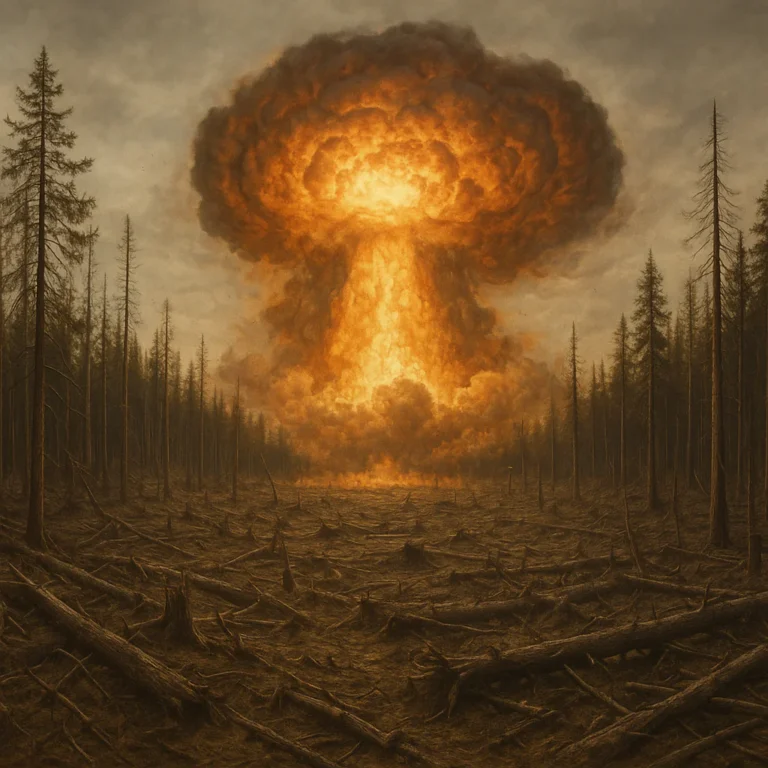
The Tunguska event flattened roughly 2,000 square kilometres of forest, yet investigators found no confirmed impact crater. That puzzle helped fuel speculation about everything from miniature black holes to alien weapons. But the trees themselves tell a more grounded story: their widespread, directional damage fits a powerful blast in the air.
So why did the black-hole theory catch on, and what evidence separates a fascinating possibility from the most likely cause? Let’s follow the clues from the Siberian forest to the science of cosmic airbursts.
Key Takeaways
- The leading explanation is an asteroid or comet airburst, not a black hole.
- No confirmed crater was found because the object likely broke apart and released most of its energy in the atmosphere.
- The black-hole hypothesis remains speculative and lacks evidence such as a confirmed passage through Earth or a matching exit signature.
- The exact object is still uncertain: scientists generally support a cosmic airburst, but its composition and precise size are debated.
- Tunguska’s lasting lesson is practical: even a relatively small near-Earth object can cause major regional damage.
Table of Contents
- ⚡️ Quick Tips and Facts
- 🌲 The Tunguska Event: What Happened in Siberia?
- Where and when did the explosion occur?
- Eyewitness accounts and the blast’s effects
- How many trees fell—and was there a crater?
- 🕳️ Was Tunguska Caused by a Black Hole?
- The miniature black hole hypothesis explained
- Could a black hole pass through Earth without leaving a crater?
- What evidence would a black-hole explanation require?
- ☄️ The Leading Explanation: An Asteroid or Comet Airburst
- How an incoming space rock created an airburst
- Estimated size, speed, altitude, and explosive energy
- Asteroid versus comet: what scientists think
- 🔬 How Scientists Investigated Tunguska
- Leonid Kulik’s expeditions and the search for a crater
- Tree patterns, seismic records, and atmospheric evidence
- What modern simulations and satellite data reveal
- 🌍 Damage, Injuries, and Environmental Consequences
- The blast zone and flattened Siberian forest
- Reported deaths, injuries, and why records are limited
- Atmospheric effects and the recovery of the landscape
- 🧩 Other Proposed Explanations—and Why They Fall Short
- Natural gas explosion and other terrestrial theories
- Antimatter, alien technology, and a “death ray” legend
- Common Tunguska misconceptions and erroneous claims
- 💥 Similar Airbursts and Other Cosmic Impact Events
- Tunguska compared with the Chelyabinsk meteor
- How airbursts differ from crater-forming impacts
- What Tunguska teaches us about planetary defense
- 🎬 Tunguska in Popular Culture and Fiction
- Books, films, games, and conspiracy stories
- Why the missing crater keeps inspiring speculation
- 🧠 Conclusion
- 🔗 Recommended Links
- ❓ FAQ
- Did a black hole cause the Tunguska event?
- Why wasn’t a crater found at Tunguska?
- How powerful was the Tunguska explosion?
- Could a similar event happen again?
- Was anyone killed in the Tunguska event?
- 📚 Reference Links
⚡️ Quick Tips and Facts
Short answer: Almost certainly not. The best-supported explanation for the 30 June 1908 Tunguska disaster is an asteroid or comet fragment that exploded in the atmosphere, not a black hole passing through Earth.
| Fact | Best-supported account |
|---|---|
| When? | 30 June 1908, in a remote part of Siberia, near the Podkamennaya Tunguska River |
| What happened? | A powerful atmospheric explosion—an airburst—flattened forest across roughly 2,000 square kilometres |
| Likely cause | A small asteroid or comet fragment, probably tens of metres across |
| Why no crater? | The object likely broke apart and released most of its energy several kilometres above the ground |
| Was a black hole proposed? | Yes. A 1973 paper explored a hypothetical primordial black hole passing through Earth. It remains an unsupported alternative, not the accepted explanation. |
| Scientific consensus | The evidence fits a cosmic airburst much better than a black hole, antimatter, or an underground explosion. |
For a deeper account of the competing explanations, see our guide to the cause of the Tunguska event. The story’s eerie missing crater helped keep unusual theories alive—but as we’ll see, “no crater” doesn’t mean “black hole.”
The key distinction: Tunguska is not unexplained in the sense that scientists have no plausible explanation. The airburst model is strongly supported, though the exact object, composition, and energy remain uncertain.
🌲 The Tunguska Event: What Happened in Siberia?
Where and when did the explosion occur?
Shortly after 7 a.m. local time on 30 June 1908, witnesses across Siberia reported an intensely bright object crossing the sky. It was followed by heat, a tremendous blast, and a shock wave powerful enough to knock people down and damage buildings far from the epicentre.
The explosion occurred over a sparsely populated region around the Podkamennaya Tunguska River. The remoteness mattered: there were no modern observatories at the site, and the first major scientific expedition did not arrive until 1927. That delay left investigators working from eyewitness testimony, tree damage, and incomplete early records.
| Detail | What researchers generally report |
|---|---|
| Date | 30 June 1908 |
| Region | Central Siberia, Russian Empire |
| Event type | Large atmospheric explosion, or airburst |
| Approximate forest damage | About 2,000–2,150 km², depending on the boundary used |
| Estimated energy | Several to a few dozen megatons of TNT in published estimates |
| Confirmed impact crater | None |
The exact figures vary because early observations were sparse and later studies use different assumptions about the incoming object and its trajectory. A clean-looking number can be tempting; in this case, a range is more honest than false precision.
Eyewitness accounts and the blast’s effects
Eyewitnesses described a bright, moving body, a flash, intense heat, and then a roar or thunderous explosion. Some accounts came from Indigenous Evenki people and Russian settlers living across the region. Their descriptions are valuable, but they were recorded at different times and under very different conditions; not every detail can be treated as a calibrated scientific measurement.
Seismic instruments far from the blast registered vibrations, while atmospheric pressure waves were detected over great distances. Reports of unusual night skies in parts of Europe also became part of the event’s lore. Together, these observations point to a large release of energy in the atmosphere, but they do not by themselves identify the object’s exact composition.
The International Meteor Organization offers useful context on meteors and fireballs: a brilliant bolide can appear dramatic in the sky even when the incoming object disintegrates before reaching the ground.
How many trees fell—and was there a crater?
The blast flattened an enormous swath of forest. Estimates commonly put the affected area near 2,000 km², with roughly 80 million trees often cited in popular accounts. Those figures are reconstructions, not a counted inventory of every fallen trunk.
The pattern was one of the most revealing clues. Trees near the centre were stripped, scorched, or left standing upright, while farther out they were toppled in a broad, roughly radial pattern. That arrangement is consistent with a powerful explosion above the ground: the shock wave spread outward and pushed trees down across a vast area.
No confirmed, substantial impact crater has been identified. That fits an airburst: an object can release most of its energy while fragmenting in the atmosphere, leaving devastation below without a neat bowl-shaped crater. The absence of a crater is intriguing—but it is not positive evidence for a black hole.
🕳️ Was Tunguska Caused by a Black Hole?
The miniature black hole hypothesis explained
In 1973, physicists proposed that a primordial black hole might have crossed Earth and caused the Tunguska explosion. Primordial black holes are hypothetical objects that, if they formed, could have originated from extreme density fluctuations in the early universe. They are not the same as the familiar black holes formed when massive stars collapse.
The proposal addressed one puzzle: How could an explosion flatten forest without leaving a conventional impact crater? In that scenario, a compact object would enter and exit Earth, depositing energy along its path rather than stopping at the surface.
It is an interesting thought experiment. It is not evidence that such an object actually did so. NASA describes primordial black holes as a theoretical possibility, not a confirmed population of objects; see its overview of black holes and the early universe.
Could a black hole pass through Earth without leaving a crater?
A sufficiently compact black hole could, in principle, pass through matter rather than behave like a rocky impactor. But “physically imaginable” is a long way from “best explanation for Tunguska.”
The black-hole interpretation needs more than a craterless blast. It must explain the witnessed fireball, the aerial explosion, the forest-fall pattern, and the lack of convincing evidence for a predicted exit event elsewhere. The proposed trajectory pointed toward the North Atlantic, but no corresponding passage has been established.
Meanwhile, an asteroid or comet airburst naturally explains why the object shone in the sky, fragmented, produced a shock wave, and left no large impact crater. The simpler explanation also matches more of the observations.
What evidence would a black-hole explanation require?
A strong black-hole case would need independently verifiable evidence, such as:
- A measured trajectory consistent with an object passing through Earth.
- A corresponding exit point or distinctive geological disturbance.
- Physical or observational evidence that a primordial black hole was involved.
- A better fit to the eyewitness, atmospheric, seismic, and tree-damage evidence than the airburst model.
That evidence has not materialized. The 1973 proposal is historically significant because it shows how scientists tested an unconventional idea—not because it overturned the mainstream explanation.
A useful rule when evaluating dramatic claims: a hypothesis can be published and still remain speculative. The question is not merely whether someone proposed it; it is whether observations support it better than competing explanations.
☄️ The Leading Explanation: An Asteroid or Comet Airburst
How an incoming space rock created an airburst
Here’s the likely sequence, step by step:
- A small cosmic body entered Earth’s atmosphere. It was travelling at high speed and heated the air in front of it.
- The object began to break apart. Intense pressure and heating can fracture a body, especially one with weak or uneven internal structure.
- Fragments released energy high above the ground. Rather than striking as one solid object, the body exploded or disintegrated in the atmosphere.
- A powerful shock wave spread outward. It flattened trees and damaged structures over a huge area.
- The airburst left no large crater. Small fragments may have survived, but no substantial, confirmed impactor has been recovered.
This is the same broad process observed in other atmospheric explosions, though Tunguska was vastly more powerful than an ordinary meteor sighting. NASA’s CNEOS fireball and bolide information provides a modern reference for how researchers catalogue energetic events.
Estimated size, speed, altitude, and explosive energy
Published estimates vary because researchers must reconstruct the event from indirect evidence. Different assumptions about the object’s density, strength, angle of entry, and fragmentation produce different results.
| Property | Commonly reported estimate | Why estimates vary |
|---|---|---|
| Object diameter | Roughly 50–80 m in many accounts | Depends on assumed composition and strength |
| Burst altitude | Several kilometres above the ground; often modeled around 5–14 km | Depends on the object’s entry angle and how it broke apart |
| Energy | Several to a few dozen megatons of TNT | Derived from blast effects and atmospheric data |
| Forest damage | Roughly 2,000–2,150 km² | Depends on how the damaged boundary is mapped |
| Crater | No confirmed large crater | Consistent with a high-altitude airburst |
These are model-based estimates, not measurements made by instruments at the explosion site. Some popular summaries quote a single energy figure, while scientific studies may provide wider ranges. That difference is not automatically a contradiction: it often reflects different models and evidence thresholds.
Asteroid versus comet: what scientists think
The broad consensus is that a small asteroid or cometary body caused the event. The exact distinction is harder. A rocky asteroid and an icy, fragile comet can both create a spectacular atmospheric explosion, and the object itself was not recovered in a way that settles the question.
| Candidate | What supports it | What remains uncertain |
|---|---|---|
| Asteroid or meteoroid | Fits the bright bolide, airburst, and widespread blast damage | No confirmed large fragment has been found |
| Comet fragment | A fragile icy body could disintegrate high in the atmosphere | The event’s physical traces do not conclusively identify comet material |
| Black hole | Historically proposed as a way to explain the lack of a crater | No confirming evidence, predicted exit signature, or demonstrated need for it |
The careful answer is therefore “asteroid or comet airburst,” not “we know exactly which kind of rock.” Confidence in the general airburst explanation is much higher than confidence in the object’s precise identity.
🔬 How Scientists Investigated Tunguska
Leonid Kulik’s expeditions and the search for a crater
Russian mineralogist Leonid Kulik helped lead early scientific investigations of the site. His expeditions began nearly two decades after the explosion, after reports and local accounts drew attention to the scale of the devastation.
Kulik expected to find a crater or meteorite fragments. Instead, investigators encountered a vast forest of damaged trees and a distinctive pattern of destruction, but no obvious impact basin. That absence helped make Tunguska a scientific mystery—and, later, a magnet for theories ranging from the plausible to the fantastical.
The lesson from the expedition is not that the event defies physics. It is that the wrong kind of impact was being sought: an object that detonates in the atmosphere may leave a different signature from one that reaches the ground intact.
Tree patterns, seismic records, and atmospheric evidence
Researchers assess Tunguska using several kinds of evidence rather than one dramatic clue:
- Fallen-tree orientation: The broad radial pattern supports an outward-moving blast wave.
- Standing, stripped trees near the centre: These are compatible with intense pressure and heat close to an aerial explosion.
- Seismic records: Distant stations registered ground vibrations associated with the event.
- Atmospheric pressure waves: Instruments detected pressure disturbances that travelled long distances.
- Eyewitness descriptions: Reports of a bright moving object, flash, heat, and blast fit an incoming body that exploded in the atmosphere.
- Soil and peat analyses: Some studies have reported possible traces of extraterestrial material, but interpretations and reproducibility have varied.
No single item proves the airburst by itself. Taken together, however, the evidence forms a coherent picture. The black-hole hypothesis has no comparable package of independent observations.
What modern simulations and satellite data reveal
Modern researchers use impact physics, blast modelling, atmospheric science, and computer simulations to test how a body of different sizes and compositions might behave. Those models can estimate how high it burst, how much energy it released, and what damage pattern it could produce.
But simulations are not time machines. Their results depend on assumptions, and the event predates modern satellite monitoring. There is no satellite video of the Tunguska explosion, and no single modern dataset can recover every missing detail.
That is why reputable summaries use qualified language: the airburst explanation is strongly supported, while exact parameters remain debated. For broader context on near-Earth objects and impact hazards, consult NASA’s Center for Near-Earth Object Studies.
🌍 Damage, Injuries, and Environmental Consequences
The blast zone and flattened Siberian forest
The explosion devastated forest across roughly 2,000 km². The damage was not a tidy circle. The incoming object’s path, the height of the explosion, local terrain, and the blast wave’s direction all shaped the pattern.
Near the centre, the pressure and heat were severe; farther away, trees were knocked down over a broad region. Because the event occurred in a remote, thinly populated area, the human toll appears to have been far lower than the landscape damage might suggest.
One reason the event remains so vivid in public memory is this mismatch: a wilderness was devastated on a scale usually associated with war, yet there was no conventional crater to point to.
Reported deaths, injuries, and why records are limited
There is no universally accepted, complete casualty record for the Tunguska event. The region was remote, its population sparse, and reliable records were limited. Reports describe people being knocked down, injured, or having property damaged at considerable distances, but specific casualty claims should be treated cautiously.
This is a case where absence of a well-documented toll is not proof that nobody was harmed. It reflects the difficulties of reconstructing an event in a remote region under the administrative and scientific conditions of 1908.
Atmospheric effects and the recovery of the landscape
The blast altered the forest, soils, and local ecology. Over time, vegetation regrew, and the landscape began its long recovery. The ecological record is complex: fire, wind damage, soil conditions, and later human activity all affect how researchers interpret what happened.
Reports of unusually bright night skies in distant regions have also been associated with Tunguska, possibly linked to material injected into the atmosphere. Such reports are intriguing but do not independently identify the object. Environmental clues help reconstruct the event; they do not turn every atmospheric anomaly into proof of an exotic cause.
🧩 Other Proposed Explanations—and Why They Fall Short
Natural gas explosion and other terrestrial theories
Over the years, researchers and commentators have proposed terrestrial explanations, including methane or natural-gas releases, unusual geological processes, and hypothetical large-scale eruptions from underground. Such ideas try to explain a major explosion without a recovered meteorite.
Their central problem is evidence. A terrestrial explosion must account for the bright object reported in the sky, the broad blast pattern, the atmospheric and seismic observations, and the event’s timing. These proposals have not displaced the airburst explanation because they do not explain the full body of evidence as well.
A fair comparison is not “Could a gas explosion happen?” It is “Does a gas explosion fit these particular observations better than an incoming cosmic body?” So far, the answer is no.
Antimatter, alien technology, and a “death ray” legend
Tunguska has attracted claims involving antimatter, UFOs, alien weapons, and the so-called “death ray” associated with Nikola Tesla. They are memorable stories, but no reliable evidence connects any of them to the 1908 event.
Antimatter would release enormous energy when it met ordinary matter, but no evidence of antimatter object or its expected signatures has been found at Tunguska. UFO and alien-weapon stories similarly lack physical support. Tesla’s supposed role is a later legend, not a documented explanation backed by evidence.
These accounts belong to the history of speculation and folklore, not to the leading scientific explanations. For more on how extraordinary stories grow around real events, explore History Hidden™’s Folklore and Legends and Mythology Stories collections.
Common Tunguska misconceptions and erroneous claims
| Claim | What the evidence supports |
|---|---|
| “Scientists have no idea what caused it.” | The exact object is unknown, but an asteroid or comet airburst is the leading explanation. |
| “No crater proves it was a black hole.” | Airbursts can devastate the ground without producing a large crater. |
| “A black hole was discovered at Tunguska.” | No black hole has been found or confirmed there. |
| “The blast’s energy is known exactly.” | Estimates vary because researchers reconstruct the event with different models. |
| “Every unusual theory is equally plausible.” | Theories must be judged by evidence; the cosmic airburst has much stronger support. |
One useful correction to sensational headlines: “proposed” does not mean “confirmed.” That distinction is especially important when a speculative hypothesis gets retold as a solved mystery.
💥 Similar Airbursts and Other Cosmic Impact Events
Tunguska compared with the Chelyabinsk meteor
The 2013 Chelyabinsk event offers a modern comparison. A smaller object exploded in the atmosphere over Russia, producing a bright fireball and a shock wave that damaged windows and injured people. Unlike Tunguska, Chelyabinsk was recorded by modern cameras and sensors.
| Feature | Tunguska, 1908 | Chelyabinsk, 2013 |
|---|---|---|
| Location | Remote Siberian forest | Populated region of Russia |
| Observation technology | Limited records and later expeditions | Dashcams, video, and modern instruments |
| Main mechanism | Atmospheric explosion | Atmospheric explosion |
| Ground effects | Vast forest damage | Broken windows and injuries, especially from glass |
| Crater | No confirmed large crater | No large impact crater from the main airburst |
Chelyabinsk shows why even a much smaller airburst can cause harm when it occurs over populated areas. NASA’s Chelyabinsk event overview explains how shock waves and window breakage create risks well beyond the visible fireball.
How airbursts differ from crater-forming impacts
An airburst happens when an incoming object breaks up and releases most of its energy in the atmosphere. A crater-forming impact occurs when a substantial object reaches the ground at high speed.
| Feature | Airburst | Ground impact |
|---|---|---|
| Where most energy is released | In the atmosphere | At or near the surface |
| Typical ground signature | Broad shock and heat damage | Crater, ejecta, and impact debris may form |
| Why no crater may appear | The object fragments before reaching the ground | The object strikes the surface |
| Tunguska fit | Strong | Poorer, given the lack of a confirmed crater |
The difference matters because the absence of a crater is expected under the leading Tunguska model. It does not require a black hole to make the evidence fit.
What Tunguska teaches us about planetary defense
Tunguska is a reminder that relatively small near-Earth objects can still cause severe regional damage. The practical lessons are straightforward:
- Find and track near-Earth objects before they approach Earth.
- Improve early warning so communities have time to respond.
- Communicate uncertainty clearly rather than presenting an estimate as exact.
- Plan for airburst effects, including broken windows and injuries from flying glass.
- Support international monitoring, because asteroids do not respect borders.
NASA’s Planetary Defense Coordination Office describes efforts to detect, track, and assess potentially hazardous objects. Tunguska’s mystery is fascinating, but its clearest modern lesson is practical: early detection matters.
🎬 Tunguska in Popular Culture and Fiction
Books, films, games, and conspiracy stories
Tunguska’s combination of huge devastation and no confirmed crater has made it irresistible to storytellers. Science fiction has used the event as a setting for everything from alien encounters to secret weapons.
One notable example is Larry Niven’s 1975 short story The Borderland of Sol, which imagines a micro black hole striking Earth. That is fiction, not a scientific account of what happened in Siberia. The distinction is worth keeping clear: stories can explore a possibility without offering evidence that it occurred.
Why the missing crater keeps inspiring speculation
A crater is a simple, visible answer. Tunguska offers no confirmed one. That gap gives the imagination room to race ahead—to black holes, antimatter, UFOs, and worse.
The scientific explanation is less cinematic but more convincing: a cosmic body exploded in the atmosphere, producing a destructive shock wave without a large ground impact. In other words, the missing crater is not a loose thread that only a black hole can tie up. It is one of the clues that helps explain why an airburst is the leading account.