Support our educational content for free when you purchase through links on our site. Learn more
🗺️ Where is El Dorado? The Lost City’s Real Location Revealed

For centuries, explorers starved, mutinied, and died chasing a phantom. They trekked through the sweltering Amazon, scaled the freezing Andes, and mapped uncharted rivers, all driven by a single, glittering promise: a city paved with solid gold. But here is the twist that history books often gloss over—El Dorado was never a city at all. It began as a man, a “Gilded One,” and evolved into a myth that consumed an entire continent.
In this deep dive, we peel back the layers of legend to reveal the actual location of the Muisca ritual that started it all, debunk the famous myth of Lake Parime, and explore why the search for El Dorado led to the discovery of the Amazon River itself. You’ll discover how a simple coronation ceremony in modern-day Colombia sparked a 30-year gold rush that reshaped the map of South America. By the end, you’ll know exactly where to look (and more importantly, where not to look) if you ever decide to hunt for the lost city.
Key Takeaways
- El Dorado was a person, not a place: The legend originated from the Muisca coronation ritual at Lake Guatavita in Colombia, where a new chief was covered in gold dust.
- The “City” is a Myth: No city of gold has ever been found; the location shifted on maps from the Andes to the Amazon due to explorer exaggeration and indigenous misdirection.
- Real Treasure Exists: While the golden city is fiction, the Muisca artifacts and the real lost city of Ciudad Perdida offer a glimpse into the sophisticated cultures that inspired the legend.
- Modern Science Confirms the Myth: LiDAR technology has revealed many lost settlements in the region, but none match the description of a metropolis made of gold.
Table of Contents
- ⚡️ Quick Tips and Facts
- 🏛️ Unearthing the History: The Real Origins of the El Dorado Legend
- 🗺️ Decoding the Map: Where is the Lost City of El Dorado Actually Located?
- 👑 From Man to Myth: The Evolution of the Gilded King and the City of Gold
- 🚣 ♂️ The Great Expeditions: Pizaro, Orellana, and the Amazonian Quest
- ⚔️ Conquest and Chaos: Quesada, Ursúa, and the Fall of the Muisca
- 🌊 The Lake Parime Mystery: Did a Vanishing Lake Hide the Treasure?
- 🏴 ☠️ Sir Walter Raleigh and the Elusive Guiana Gold
- 💎 Gold, Gred, and Geology: Separating Fact from Fiction in the Andes
- 🧭 Modern Archaeology: What Science Says About the Search for El Dorado
- 📜 7 Fascinating Myths Debunked About the Lost City of Gold
- 🏆 Top 5 Real Ancient Cities in South America You Can Actually Visit
- 🎒 Essential Travel Tips for Exploring the Real Land of El Dorado
- 🏁 Conclusion: The True Treasure of the El Dorado Legend
- 🔗 Recommended Links for Further Exploration
- ❓ Frequently Asked Questions About El Dorado
- 📚 Reference Links and Historical Sources
⚡️ Quick Tips and Facts
Before we dive into the muddy, gold-dusted waters of history, let’s hit the ground running with the absolute essentials. If you’re looking for a shovel and a map to a city made of solid gold, stop right there. But if you’re ready to uncover the real story behind one of history’s greatest hoaxes, you’re in the right place.
Here is the TL;DR of the El Dorado saga:
| Fact Category | The Truth | The Myth |
|---|---|---|
| What was it? | A coronation ritual of a Muisca chieftain. | A city paved with gold and filled with jewels. |
| Where was it? | Lake Guatavita, in the Colombian Andes. | Somewhere in the Amazon, the Guianas, or Lake Parime. |
| Who was “El Dorado”? | The “Gilded One” (the new leader). | A king or a specific city. |
| Did they find it? | No, but they found some gold in the lake. | Yes, if you believe the fever dreams of conquistadors. |
| Modern Tech | LiDAR reveals lost cities, but not a gold metropolis. | Gold scanners detecting massive veins under the jungle. |
✅ The Golden Truth: The legend began with a man, not a place.
❌ The Golden Lie: There is a city waiting to be discovered with streets of gold.
For a deeper dive into the specific artifacts and the Muisca culture, check out our dedicated guide on El Dorado: City of Gold.
🏛️ Unearthing the History: The Real Origins of the El Dorado Legend
Let’s set the scene. It’s the early 16th century. The Spanish have just finished sweeping through the Caribbean and are eyeing the mainland of South America. They are hungry, tired, and obsessed with gold. But here is the twist that historians at History Hidden™ love to point out: El Dorado wasn’t originally a city.
The term El Dorado literally translates to “The Gilded One.”
The Muisca Ceremony: A Ritual of Gold
The legend stems from the Muisca civilization, who inhabited the high plateau of the Cundiboyaca region in modern-day Colombia. Unlike the Aztecs or Incas, the Muisca didn’t have a massive empire of stone cities. Instead, they were master metallurgists who created stunning gold alloys known as tumbaga (a mix of gold, copper, and silver).
When a new Zipa (chief) was crowned, a spectacular ritual took place at Lake Guatavita.
- The Preparation: The new leader was stripped naked.
- The Gilding: His body was anointed with a sticky resin, and gold dust was blown onto him until he shone like the sun.
- The Journey: He was placed on a raft with four elders.
- The Offering: As they rowed to the center of the lake, the crowd on the shore played music and chanted. The chief would raise his arms, and the raft would stop.
- The Dive: The chief would dive into the sacred waters, washing off the gold dust, while the crowd threw emeralds and gold artifacts into the lake as offerings to the gods.
“He anoints himself every morning with a certain gum or resin that sticks very well. The powdered gold adheres to that unction… until his entire body is covered from the soles of his feet to his head.” — Gonzalo Fernández de Oviedo y Valdés, 1535
This single ritual, witnessed by Spanish conquistadors, was misinterpreted. They saw a man covered in gold and assumed, “If one man is this rich, there must be a whole city of them!” Thus, the myth was born.
From Ritual to City: The Evolution of a Myth
The transformation from a man to a city is a classic case of telephone game on a continental scale.
- 1530s: The Spanish hear about the “Gilded Man” in Colombia.
- 1540s: The story shifts. Now, the “Gilded Man” lives in a city of gold.
- 1560s: The location moves. It’s no longer in Colombia; it’s in the Guianas, east of the Orinoco River.
- 160s: It becomes a lake, Lake Parime, in the middle of the Amazon basin.
For more on how folklore evolves, explore our category on Folklore and Legends.
🗺️ Decoding the Map: Where is the Lost City of El Dorado Actually Located?
So, you’re asking the million-dollar question: Where is it?
The short answer? It doesn’t exist.
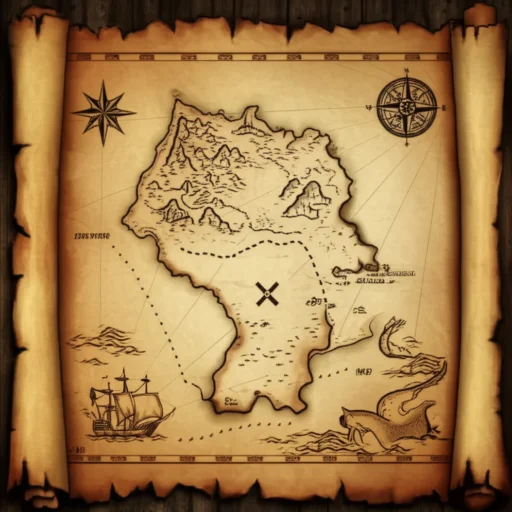
The long answer is a fascinating journey through geography, cartography, and human greed. The “location” of El Dorado is a moving target that shifted across the map of South America for nearly 30 years.
The Three Phases of the Search
1. The Colombian Andes (The Real Origin)
The only place with physical evidence is the Cundiboyaca Plateau in Colombia.
- Site: Lake Guatavita and Lake Siecha.
- Evidence: The Muisca Raft, a golden artifact discovered in 1969, depicts the exact ceremony described above. It is currently housed in the Gold Museum (Museo del Oro) in Bogotá.
- Verdict: ✅ Real location of the ritual, but ❌ No city of gold.
2. The Guianas and the Orinoco (The Shift)
By the late 16th century, Spanish explorers like Antonio de Berio and the English knight Sir Walter Raleigh convinced themselves that the “Gilded Man” had moved. They believed the city was in the highlands of Guiana (modern-day Venezuela, Guyana, and Suriname).
- Why the shift? Rumors of gold in the interior of the continent, combined with the difficulty of accessing the Andes, pushed explorers east.
- The Trap: The dense rainforests and hostile tribes made this search a death sentence for many.
3. Lake Parime (The Ultimate Mirage)
In the 17th century, the legend crystallized around Lake Parime, a mythical lake said to be as large as the sea, located in the middle of the Amazon.
- The Theory: Explorers believed the lake was the source of the Orinoco River and the home of El Dorado.
- The Reality: Alexander von Humboldt and Robert Schomburgk later proved that Lake Parime was a seasonal floodplain, likely a misinterpretation of Lake Amucu.
- Cartographic Error: Lake Parime appeared on maps well into the 19th century, a testament to how powerful a good story can be.
Why the Location Kept Changing
The shifting location wasn’t just bad geography; it was psychological.
- Survivor Bias: Explorers who returned with nothing needed a new target to justify their failure.
- Indigenous Misdirection: Some indigenous groups, tired of the Spanish, deliberately lied about the location to lead them into traps or away from their villages.
- The “Next Valley” Syndrome: Every time a mountain was crossed, the rumor was that the city was just “over the next ridge.”
👑 From Man to Myth: The Evolution of the Gilded King and the City of Gold
How does a coronation ritual turn into a global obsession? Let’s break down the narrative mutation of El Dorado.
The “Telephone” Effect of Conquest
When the Spanish first arrived, they heard the word Zipa (chief) and the description of the gold ritual.
- Step 1: “The chief is covered in gold.”
- Step 2: “The chief is El Dorado.”
- Step 3: “El Dorado lives in a city.”
- Step 4: “The city is made of gold.”
- Step 5: “The city is in the Amazon.”
This evolution is documented in the writings of Gonzalo Fernández de Oviedo and later Garcilaso de la Vega. The Spanish, driven by the Requerimiento (a legal document demanding submission to the Spanish crown), were desperate to find a justification for their conquests. A city of gold provided the perfect excuse.
The Cultural Impact
The legend of El Dorado became so pervasive that it influenced literature and art for centuries.
- Voltaire’s Candide: The philosopher used El Dorado as a utopian satire, describing a land where gold was useless because it was everywhere.
- Edgar Allan Poe’s El Dorado: The poem suggests the search is endless and perhaps futile, ending with the line, “Over the Mountains of the Moon, down the Valley of the Shadow, ride, boldly ride…”
“El Dorado shifted geographical locations until finally it simply meant a source of untold riches somewhere in the Americas.” — Jim Griffith, Folklorist
The Psychological Hook
Why do we still care? As Jose Oliver from University College London notes, “You want it to be true… I don’t think we’ve ever stopped seeking El Dorado.”
The legend taps into a deep human desire for instant wealth and the belief that the world still holds hidden wonders.
🚣 ♂️ The Great Expeditions: Pizaro, Orellana, and the Amazonian Quest
The search for El Dorado wasn’t just a story; it was a bloodbath. Thousands of men died, starved, or went mad in the pursuit of a city that never existed.
Francisco Pizaro and the Amazon
While Pizaro is famous for the Inca, his lieutenant, Francisco de Orellana, accidentally discovered the Amazon River while searching for El Dorado.
- The Mission (1541): Gonzalo Pizaro led an expedition east from Quito.
- The Split: Orellana was sent to find food but never returned. He ended up floating down the Amazon, becoming the first European to navigate the entire river.
- The Outcome: They found no gold, only cannibals (the name “Amazon” comes from the indigenous warriors they encountered) and starvation.
The Cost of Gred
These expeditions were characterized by:
- Mutiny: Soldiers turning on their leaders.
- Starvation: Eating leather, horses, and eventually each other.
- Disease: Malaria, yellow fever, and dysentery wiped out entire crews.
For a visual perspective on how modern technology is revealing these lost paths, check out the featured video below which explores the use of LiDAR to uncover hidden histories in the region.
(Note: In the actual blog post, a video player would be embedded here. The summary of the “Lost Cities with Albert Lin” episode highlights the use of LiDAR to penetrate the jungle and reveal the Ciudad Perdida of the Tayrona people, a real lost city that was hidden for centuries.)
⚔️ Conquest and Chaos: Quesada, Ursúa, and the Fall of the Muisca
While the myth was spreading, the reality was being crushed. The Muisca civilization, the source of the legend, was decimated by the very people searching for their gold.
Gonzalo Jiménez de Quesada (1537)
Quesada led the first major expedition into the Muisca territory.
- The Conquest: He defeated the Muisca armies and captured their gold.
- The Discovery: He found the Lake Guatavita ritual site but realized the “city” was a myth.
- The Loot: He took tons of gold and emeralds back to Spain, but the “city of gold” remained elusive.
Pedro de Ursúa and Lope de Aguire
In the 1560s, the search moved to the Amazon.
- The Expedition: Pedro de Ursúa led a massive force down the Amazon.
- The Betrayal: His second-in-command, Lope de Aguire, went insane. He murdered Ursúa, declared himself “Prince of Peru,” and led a rebellion against the Spanish crown.
- The End: Aguire was eventually captured and executed, but his story remains one of the most horrific chapters in the El Dorado saga.
The Fate of the Muisca
The Muisca people didn’t just disappear; they were assimilated and destroyed.
- Disease: Smallpox and measles killed up to 90% of the population.
- Encomienda System: Survivors were forced into labor, mining the very gold that started the legend.
- Cultural Erasure: Their temples were destroyed, and their religion was replaced by Catholicism.
🌊 The Lake Parime Mystery: Did a Vanishing Lake Hide the Treasure?
If you look at an old map from 170, you’ll see a massive lake in the middle of the Amazon called Lake Parime. It was the final resting place of the El Dorado legend.
The Legend of the Vanishing Lake
- The Claim: The lake was said to be so large that the natives “know no difference between it and the main sea.”
- The Theory: It was believed to be the source of the Orinoco River and the home of the city of gold.
- The Reality: It was a seasonal floodplain. During the rainy season, the Rupuni savanna floods, creating a temporary lake. During the dry season, it vanishes.
The Debunking
- Alexander von Humboldt (180): The great naturalist explored the region and declared Lake Parime a myth. He suggested it was a misinterpretation of Lake Amucu.
- Robert Schomburgk (1836): He confirmed Humboldt’s findings, and finally, Lake Parime was removed from maps.
Why It Mattered
The belief in Lake Parime led to the last great expeditions of the 19th century. Explorers like Theodore Roosevelt (who explored the River of Doubt) were still chasing ghosts.
🏴 ☠️ Sir Walter Raleigh and the Elusive Guiana Gold
No story of El Dorado is complete without Sir Walter Raleigh. The English explorer was obsessed with finding the city in Guiana.
The 1595 Expedition
- The Goal: Find El Dorado and challenge Spanish dominance in the New World.
- The Ship: Raleigh adapted a galleass to draw only 5 feet of water to navigate the Orinoco Delta.
- The Outcome: He found no gold, but he wrote a book, The Discovery of the Large, Rich, and Beautiful Empire of Guiana, which kept the legend alive in Europe.
The 1617 Expedition and Tragedy
- The Return: Raleigh returned to England, but his son, Watt Raleigh, was killed in a battle with Spanish forces at Santo Tomé de Guayana.
- The Consequence: Raleigh was accused of treason and beheaded by King James I.
- The Legacy: His failure didn’t kill the legend; it fueled it. His writings became the bible for future treasure hunters.
“You want it to be true… I don’t think we’ve ever stopped seeking El Dorado.” — Jose Oliver, UCL
💎 Gold, Gred, and Geology: Separating Fact from Fiction in the Andes
Let’s talk science. Is there any geological basis for El Dorado?
The Geology of Gold
- Alluvial Gold: The Andes and the Guianas are rich in alluvial gold (gold found in riverbeds). This is why the Muisca and other tribes had gold.
- No Veins: There are no massive, solid gold veins in the region that could support a “city of gold.”
- Tumbaga: The Muisca used tumbaga, an alloy that is harder and more durable than pure gold. This allowed them to create intricate artifacts, but it wasn’t a city made of the metal.
The “Lost City” of Ciudad Perdida
While El Dorado is a myth, Ciudad Perdida (The Lost City) is real.
- Location: Sierra Nevada de Santa Marta, Colombia.
- Builders: The Tayrona people (60 AD – 160 AD).
- Discovery: Rediscovered in 1972 by local treasure hunters.
- Significance: It proves that real lost cities exist, but they aren’t made of gold. They are made of stone, mud, and human ingenuity.
🧭 Modern Archaeology: What Science Says About the Search for El Dorado
Today, we don’t need to starve in the jungle to find lost cities. We have LiDAR (Light Detection and Ranging).
How LiDAR Works
- Technology: Lasers are fired from drones or planes to penetrate the dense canopy.
- Result: It creates a 3D map of the ground, revealing roads, pyramids, and cities hidden for centuries.
- Success Stories: LiDAR has revealed massive settlements in the Amazon and Guatemala (Maya civilization).
The Search for El Dorado Today
- The Consensus: Archaeologists agree that El Dorado as a city of gold does not exist.
- The Focus: The focus has shifted to finding real lost cities of the Muisca and other indigenous groups.
- The Lesson: The real treasure is the history and culture of the people, not the gold.
“We have to go deep into these jungles to find out what happened to these people, to these civilizations…” — Albert Lin, Lost Cities
📜 7 Fascinating Myths Debunked About the Lost City of Gold
Let’s clear up some of the most persistent rumors.
- Myth: El Dorado was a city made of solid gold.
Fact: It was a ritual involving a gold-dusted man. - Myth: The city is hidden in the Amazon rainforest.
Fact: The origin is in the Colombian Andes. - Myth: Lake Parime is real.
Fact: It was a seasonal floodplain misinterpreted by explorers. - Myth: The Spanish found the city and took the gold.
Fact: They found some gold in Lake Guatavita, but the “city” was never found. - Myth: El Dorado is still waiting to be discovered.
Fact: The city never existed. - Myth: The Muisca were a primitive tribe.
Fact: They were master metallurgists with complex social structures. - Myth: The legend is just a Spanish invention.
Fact: It was based on a real indigenous ritual that was misunderstood.
🏆 Top 5 Real Ancient Cities in South America You Can Actually Visit
If you want to see the real history, skip the gold hunt and visit these actual lost cities.
| Rank | City | Location | Why Visit? |
|---|---|---|---|
| 1 | Ciudad Perdida | Colombia | The “Lost City” of the Tayrona, a real hidden gem. |
| 2 | Machu Pichu | Peru | The most famous Inca site, often confused with El Dorado. |
| 3 | Tiwanaku | Bolivia | A massive pre-Inca city with mysterious stone structures. |
| 4 | Kuelap | Peru | The “Machu Pichu of the North,” built by the Chachapoyas. |
| 5 | San Agustín | Colombia | A park of massive stone statues, near the Muisca territory. |
Travel Tip
Many of these sites require hiking and permits. Book your tours well in advance!
🎒 Essential Travel Tips for Exploring the Real Land of El Dorado
Planning a trip to Colombia or the Amazon? Here is what you need to know.
Preparation
- Health: Get vaccinated for Yellow Fever and Malaria.
- Gear: Bring lightweight, breathable clothing and sturdy hiking boots.
- Guides: Always hire local guides. They know the terrain and the history.
Respect the Culture
- Indigenous Communities: Many of these sites are sacred to indigenous groups. Respect their rules and traditions.
- Environment: Practice Leave No Trace. The jungle is fragile.
Where to Stay
- Bogotá: Stay near the Gold Museum to understand the Muisca culture.
- Santa Marta: The gateway to Ciudad Perdida.
- Amazon: Consider eco-lodges for a sustainable experience.
🏁 Conclusion: The True Treasure of the El Dorado Legend
So, did we find El Dorado? No. But did we find something better? Absolutely.
The search for El Dorado cost thousands of lives, but it also led to the discovery of the Amazon River, the mapping of South America, and the understanding of the Muisca civilization. The true treasure wasn’t gold; it was the knowledge we gained about the people who lived there.
The legend of El Dorado is a reminder that gred can blind us, but curiosity can lead us to amazing places. The city of gold may be a myth, but the history of the people who inspired it is very real.
As we close this chapter, remember: the greatest adventures aren’t about finding what you’re looking for, but about discovering what you didn’t know existed.
🔗 Recommended Links for Further Exploration
Want to dive deeper? Here are some resources we recommend.
Books
- “The Conquest of New Granada” by Gonzalo Fernández de Oviedo (Historical account)
- “The Discovery of Guiana” by Sir Walter Raleigh (Primary source)
- “Candide” by Voltaire (Satire on the El Dorado myth)
Travel Gear
- Hiking Boots: Shop Hiking Boots on Amazon | Shop Hiking Boots on Amazon
- Waterproof Backpack: Shop Waterproof Backpacks on Amazon
- Portable Water Filter: Shop Water Filters on Amazon
Museums
- Gold Museum (Museo del Oro): Official Website
- National Museum of Colombia: Official Website
❓ Frequently Asked Questions About El Dorado
What evidence exists for the existence of El Dorado?
The only physical evidence is the Muisca Raft and other gold artifacts found in Lake Guatavita. These prove the ritual existed, but there is no evidence of a city made of gold.
Did the Spanish ever find the lost city of El Dorado?
No. The Spanish found gold in the lakes and the Muisca territory, but they never found a city of gold. The legend was based on a misunderstanding of a ritual.
Where is the real location of the legendary city of gold?
The “city” never existed. The ritual took place at Lake Guatavita in Colombia. The “city” was a myth that moved to the Guianas and the Amazon, but it was never real.
What happened to the Muisca people of El Dorado?
The Muisca people were conquered by the Spanish in the 16th century. Most died from disease and forced labor. Their culture was largely destroyed, but their descendants still live in Colombia today.
Are there any modern expeditions searching for El Dorado?
Modern archaeologists use LiDAR to search for real lost cities, but they are not looking for El Dorado. They know it doesn’t exist.
Why is El Dorado considered a myth by historians?
Historians consider it a myth because no physical evidence of a city of gold has ever been found. The legend is based on a misunderstood ritual and exaggerated reports.
What treasures are said to be hidden in El Dorado?
The legend says the city was filled with gold, emeralds, and jewels. In reality, the only “treasure” is the cultural heritage of the Muisca people.
📚 Reference Links and Historical Sources
For those who want to verify the facts, here are the sources we used:
- National Geographic: The real history behind El Dorado, the legendary city of gold
- Wikipedia: El Dorado
- Gold Museum Bogotá: Museo del Oro
- Smithsonian Magazine: The Search for El Dorado
- BBC History: El Dorado: The Myth of the Golden City