Support our educational content for free when you purchase through links on our site. Learn more
How Do I Know If I’m Related to Genghis Khan? 🧬


How do I know if I am related to Genghis Khan? Start with documented family records, then use DNA testing as supporting evidence—not as a definitive answer. No authenticated DNA sample from Genghis Khan is available, so no consumer test can prove you descend from him.
The famous “one in 200 men” claim comes from a study of a widespread paternal-line genetic cluster in Asia. Researchers suggested it might have expanded from a powerful man around the time of the Mongol Empire, but they could not establish that the man was Genghis Khan.
That leaves a fascinating possibility, not a personal verdict. Your best clues are a carefully researched family tree and, if you’re investigating an unbroken father-to-son line, an appropriate Y-DNA test. Even then, the evidence can point to a lineage without naming its medieval ancestor.
Key Takeaways
- No DNA test can currently confirm descent from Genghis Khan: researchers lack an authenticated sample from him.
- The “one in 200 men” statistic is often oversimplified: it refers to a widespread Y-chromosome lineage, not people proven to be his descendants.
- Y-DNA traces one direct paternal line: autosomal DNA tests can help find relatives and explore broader ancestry, but neither proves a link to the Khan.
- Build a documented family tree first: records, family interviews, and reputable archives give genetic results useful context.
- A shared haplogroup is not proof of a famous ancestor: it indicates a broader paternal-line connection, not a verified relationship to a specific historical person.
Table of Contents
- ⚡️ Quick Tips and Facts
- 🏹 Genghis Khan’s Family Tree: What History Can—and Can’t—Tell Us
- The Mongol Empire and the ruler’s known descendants
- Why the “one in 200 men” claim made headlines
- 🧬 The Genetic Evidence Behind the Genghis Khan Ancestry Claim
- What the 2003 Y-chromosome study actually found
- Why researchers could not identify Genghis Khan’s DNA
- How Y-DNA inheritance differs from overall ancestry
- 🔎 How to Find Out If You’re Related to Genghis Khan
- Start with your family tree and documented ancestors
- Look for Mongolian, Central Asian, and Eurasian family connections
- Use historical records, family stories, and reputable archives
- Build a paper trail before testing your DNA
- 🧪 Can a DNA Test Prove You Descend from Genghis Khan?
- What consumer DNA tests can reveal
- What Y-DNA testing can—and cannot—show
- Why ancestry estimates are not proof of a famous ancestor
- DNA testing privacy and consent considerations
- 🧭 The “Genghis Khan Y-Chromosome” Explained
- The C2 haplogroup and its geographic distribution
- Why sharing a haplogroup does not establish a direct descent
- How family lines can disappear or spread over time
- 🌏 Could You Be a Distant Descendant Through Another Line?
- Direct descent versus genetic inheritance
- Why many people may have a genealogical ancestor without detectable DNA
- How royal and imperial family trees become complicated
- ⚠️ Common Myths About Genghis Khan DNA and Descendants
- “One in 200 people are definitely his descendants”
- “A DNA test can identify Genghis Khan himself”
- “Mongolian ancestry proves descent from the Khan”
- 📚 Best Resources for Mongolian Genealogy and DNA Research
- Historical records and scholarly studies
- Genealogy databases and DNA projects
- Questions to ask a genealogist or genetic counselor
- Conclusion
- Recommended Links
- FAQ
- Reference Links
Quick Tips and Facts
Short answer: You may be related to Genghis Khan, but no currently available consumer DNA test can confirm that you are his descendant. There is no authenticated DNA sample from the historical ruler to use as a definitive comparison.
| Quick fact | What it means |
|---|---|
| The famous genetic finding concerns a Y-chromosome lineage, not every descendant | It traces one direct paternal line: father to son to son. |
| A 2003 study identified a widespread Y-chromosome cluster across parts of Asia | Researchers proposed that it could have expanded from a powerful man living roughly 1,000 years ago; Genghis Khan was a possible, not proven, candidate. |
| The study did not identify Genghis Khan’s DNA | His remains have not been authenticated and genetically tested. |
| Women can still investigate family ancestry | They can use autosomal DNA tests and, for a direct paternal line, ask an appropriate male relative to take a Y-DNA test. |
| A shared haplogroup is not proof of a famous ancestor | It can point to a broad paternal-line relationship, not identify a specific historical person. |
The first step is separating “I may descend from him” from “a test proves I descend from him.” Those are very different claims. For a vivid reminder of how history, legend, and missing evidence can mingle around the Mongol ruler, see our article on the cursed tomb of Genghis Khan.
🏹 Genghis Khan’s Family Tree: What History Can—and Can’t—Tell Us

The Mongol Empire and the ruler’s known descendants
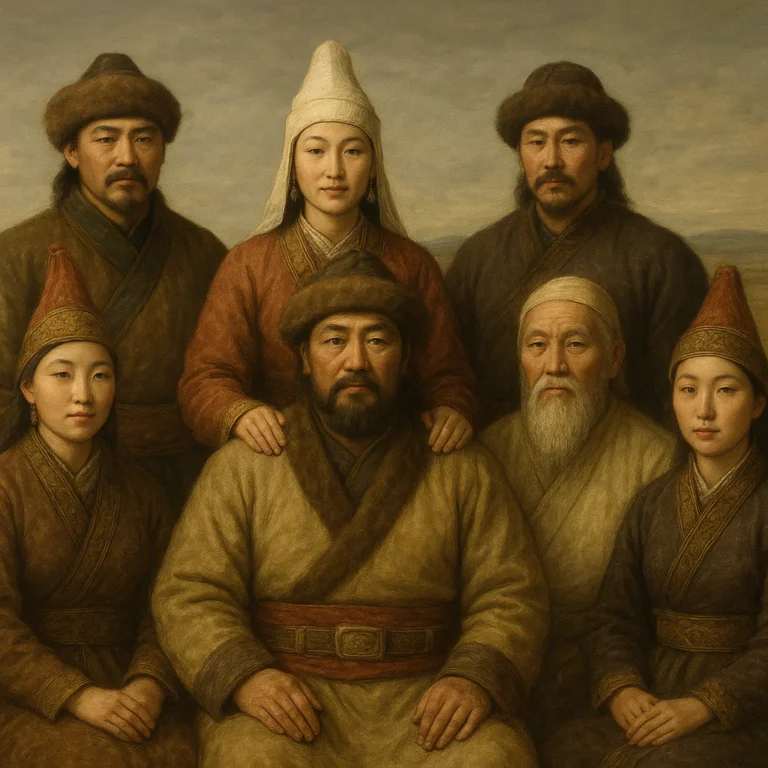
Genghis Khan, born Temüjin, founded the Mongol Empire in the early 13th century. His sons and grandsons governed vast territories, and later Mongol dynasties and ruling families claimed descent from his house. Historical records establish that his descendants became politically influential; they do not provide a complete, verified family tree connecting every present-day claimant to him.
That distinction matters. A person can have a historically plausible route of descent without having documents for every generation. Conversely, a family story about a royal ancestor may be meaningful to a family without constituting proof.
For context on how conquest, memory, and historical storytelling shape famous legacies, explore our Folklore and Legends and Mythology Stories collections. Genghis Khan’s story has attracted both careful scholarship and plenty of dramatic retelling; the two should not be mistaken for the same thing.
Why the “one in 200 men” claim made headlines
A widely reported 2003 study found a Y-chromosome lineage in about 8% of men in a large region of Asia and roughly 0.5% of men worldwide, according to the researchers’ estimates. The lineage appeared to have expanded rapidly from a man who lived around 1,000 years ago.
That led to the memorable “one in 200 men” headline. But the study did not test Genghis Khan, identify his remains, or demonstrate that every man carrying the lineage descends from him. The authors proposed that the lineage might have belonged to a male ancestor associated with the Mongol empire’s expansion, with Genghis Khan as a plausible candidate.
A useful way to read the headline is: some men share a paternal lineage that may have expanded during the Mongol era. That is intriguing. It is not a certificate bearing the Khan’s seal.
🧬 The Genetic Evidence Behind the Genghis Khan Ancestry Claim
What the 2003 Y-chromosome study actually found
In 2003, geneticists published a study of Y-chromosome variation across Asia. They identified a distinctive cluster found at high frequency in several populations, with geographic patterns consistent with a rapid expansion across the region. The researchers estimated that the lineage could have originated around 1,000 years ago and suggested that social and political power may have helped it spread.
The study’s interpretation connected genetics with history: a high-status man with many male descendants could leave a disproportionately large Y-chromosome legacy. Genghis Khan and his close male relatives lived in the right broad historical setting to be candidates. Yet the inference rested on population patterns and historical context—not a sample from the ruler.
| Claim | What the evidence supports | What it does not establish |
|---|---|---|
| A particular Y-chromosome cluster is widespread in parts of Asia | A paternal lineage expanded substantially | That Genghis Khan personally carried it |
| The lineage likely expanded about 1,000 years ago | Its estimated age broadly overlaps the Mongol period | The identity of its founding man |
| About 0.5% of men worldwide may carry it | A notable frequency estimate from the study’s samples and model | That 0.5% of all people are confirmed descendants |
| The lineage may be linked to Mongol-era social power | A historically plausible explanation | A documented family tree to Genghis Khan |
For the original scientific paper, see Zerjal and colleagues’ 2003 study in the American Journal of Human Genetics. Its cautious logic is stronger than the simplified headline: the lineage is real; its famous proposed owner remains uncertain.
Why researchers could not identify Genghis Khan’s DNA
To establish a direct genetic match, researchers would need a reliably authenticated sample from Genghis Khan—or from remains that could be demonstrated to belong to him—and a sound comparison method. No such authenticated reference genome is available.
The reported location of his tomb remains uncertain, and the secrecy surrounding his burial has fed centuries of speculation. Without verified remains, researchers cannot say, “This is his DNA; compare yours to it.” They can only investigate lineages whose age, geography, and history make a connection conceivable.
The California Academy of Sciences’ Ask a Geneticist explanation makes the key limitation clear: without the ruler’s DNA, testing cannot confirm a relationship to him. That is the evidence boundary, not a technicality.
How Y-DNA inheritance differs from overall ancestry
Y-DNA follows one narrow route through a family tree:
father → son → son → son
Most men inherit a Y chromosome from their father. Daughters do not inherit their father’s Y chromosome, though they may pass on family ancestry through other parts of their DNA. The Y chromosome changes slowly over generations, so specific mutations can help researchers compare direct paternal lines.
Autosomal DNA works differently. You inherit a reshuffled mix of DNA from many ancestors, and that mix changes with every generation. After roughly 800 years—around 30 to 35 generations, depending on the assumed generation length—you may have a genealogical ancestor from whom you inherited no detectable autosomal segment.
| DNA type | Inherited from | Best suited to | Main limitation |
|---|---|---|---|
| Y-DNA | Father to son | One direct paternal line | Only follows one line; requires a person with a Y chromosome |
| Mitochondrial DNA (mtDNA) | Mother to children; daughters pass it onward | One direct maternal line | Does not trace Genghis Khan’s own paternal line |
| Autosomal DNA | Both parents, with recombination | Broad ancestry and close-to-moderate cousin matching | Distant ancestors may leave no detectable DNA |
So if a company reports a broad regional ancestry estimate, that does not automatically connect you to a particular medieval ruler. Ancestry is a family-tree concept; DNA is evidence from the pieces of that tree you happened to inherit.
🔎 How to Find Out If You’re Related to Genghis Khan
Start with your family tree and documented ancestors
Begin with what your family already knows, but treat oral history as a lead rather than a verdict. Write down names, places, dates, languages, migrations, and family relationships. Ask relatives where a story came from and whether documents support it.
A practical first pass:
- Interview older relatives. Record names and spellings exactly as they remember them, including alternate spellings.
- Build backward one generation at a time. Collect birth, marriage, death, census, immigration, and military records where available.
- Track locations, not just surnames. Borders and place names changed; a family’s historic home may now be in another country.
- Separate evidence from family lore. Label each claim as documented, reported, or uncertain.
- Look for a continuous chain. A famous ancestor is only as credible as the links connecting you to that ancestor.
Our historians have seen family research become much more productive once relatives stop asking, “Are we descended from a famous person?” and start asking, “What can we prove about the next generation back?” That less glamorous question is usually the one that opens the door.
Look for Mongolian, Central Asian, and Eurasian family connections
A documented connection to Mongolian or Central Asian history could make a descent hypothesis worth investigating, but geography alone does not prove kinship. The Mongol Empire covered an enormous area, and populations moved, mixed, and changed political identities over centuries.
Useful clues might include:
- Family records naming a Mongolian, Central Asian, or Eurasian place of origin
- A documented connection to a historically known ruling or aristocratic family
- Oral histories that can be cross-checked against records
- A direct paternal line with a Y-DNA pattern relevant to a research question
Avoid treating ethnicity estimates as a shortcut. A DNA company may estimate regional ancestry based on its reference panels; that estimate is not a medieval pedigree. Reference databases and regional categories also vary between companies and can change as datasets improve.
Use historical records, family stories, and reputable archives
For ancestors who lived in regions with accessible archives, civil registration, religious records, migration documents, or family genealogies may offer more useful evidence than a broad DNA percentage. In parts of Eurasia, records may be fragmented, written in different languages, or held by local institutions rather than searchable international databases.
Helpful habits:
- Search for variant spellings and transliterations.
- Keep a source citation for every record.
- Note whether a record is original or a later copy.
- Compare independent records rather than relying on a single family document.
- Consult specialists when records involve older scripts, regional languages, or dynastic genealogies.
If a claimed descent runs through a royal or noble line, ask a professional genealogist to test the chain generation by generation. A famous name in the middle of a pedigree does not repair a missing generation on either side.
Build a paper trail before testing your DNA
DNA testing can help answer focused questions, but it works best when you know what you are trying to test. Is the question about your broad ancestry, a possible cousin match, or one uninterrupted paternal line? Those require different evidence.
Before ordering a test:
- Draw the specific line you want to investigate.
- Identify the oldest known ancestor on that line.
- Determine whether the line is paternal, maternal, or mixed.
- Check which living relative could provide the most informative sample.
- Read the provider’s privacy, data-sharing, and sample-retention policies.
- Decide in advance what result would—and would not—change your conclusion.
This prevents a common disappointment: buying a general ancestry test, seeing a regional estimate, and expecting it to name a 13th-century ancestor. It cannot.
🧪 Can a DNA Test Prove You Descend from Genghis Khan?
What consumer DNA tests can reveal
Services such as AncestryDNA, 23andMe, FamilyTreeDNA, and MyHeritage DNA can provide different kinds of information, depending on their tests, databases, and features. Autosomal tests can identify genetic relatives who have also tested and estimate broad regional ancestry. FamilyTreeDNA also offers dedicated Y-DNA testing for eligible customers.
These services can be useful for family history, but none can compare your DNA with a verified sample from Genghis Khan. A match to a living person, a regional ancestry estimate, or a haplogroup result cannot independently prove descent from him.
| Research question | Potentialy useful tool | What a result can support |
|---|---|---|
| Where might parts of my ancestry come from? | Autosomal DNA test | A company’s estimate based on its reference data |
| Can I find genetic relatives? | Autosomal matching | Possible relationships to tested people, with varying confidence |
| What is my direct paternal-line haplogroup? | Y-DNA test | Placement on a paternal-line branch |
| Can I prove that Genghis Khan was my ancestor? | No consumer test alone | Not without authenticated reference DNA and a documented lineage |
What Y-DNA testing can—and cannot—show
A Y-DNA test may help compare men who share a direct paternal line. More detailed tests can examine more markers or genetic variants, helping place a person on a finer branch of the Y-chromosome tree. Results can be useful for identifying paternal-line relatives and studying ancestral surname or population history.
But the test answers “Which paternal-line branches do I share with these people?”, not “Was Genghis Khan my ancestor?” Even a result associated with a lineage discussed in the 2003 paper would not establish that the historical ancestor was the Khan. The lineage may have arisen in another man, and several generations of powerful families could have shared it.
FamilyTreeDNA’s Y-DNA testing information explains the company’s paternal-line testing options. Read the test description carefully: marker counts, matching features, and interpretive claims are not interchangeable with proof of descent.
Why ancestry estimates are not proof of a famous ancestor
An ancestry estimate is a statistical comparison between your DNA and a company’s reference samples. It can be useful for exploring broad population connections, but it does not identify an individual ancestor unless there is a well-supported genetic comparison and a genealogical chain.
A result such as “Central Asian ancestry” may reflect many possible ancestors and historical movements. It cannot distinguish Genghis Khan from millions of other people who lived in the same region or period. Likewise, a close DNA match might help identify a family connection, but you would still need records to show how that connection fits into a historical pedigree.
DNA testing privacy and consent considerations
DNA data is personal and may also reveal information about relatives who never tested. Before submitting a sample, review:
- Whether the company uses data for research or shares it with third parties
- Whether law enforcement access is addressed in its policy
- How you can download or delete your data
- Whether biological relatives may be unexpectedly identified
- Whether your account settings permit relative matching
A family-history discovery can be joyful, awkward, or both. Give relatives room to choose whether they want to participate, and do not upload someone else’s genetic data without consent.
🧭 The “Genghis Khan Y-Chromosome” Explained
The C2 haplogroup and its geographic distribution
The lineage discussed in the 2003 study is often associated in popular accounts with the C2-M217 branch of the Y-chromosome tree, though genetic classification and nomenclature can change as researchers refine branches. A haplogroup is a broad grouping of paternal or maternal lines defined by shared genetic mutations.
The important point is not to memorize a letter-and-number label. It is to understand what the label means: a shared paternal-line branch, not a named individual. A haplogroup can contain many branches that split from one another long before or after the historical period under discussion.
Why sharing a haplogroup does not establish a direct descent
Two men can share a haplogroup because they descend from a paternal-line ancestor who lived centuries or millennia ago. That ancestor may not be famous, and the common ancestor could be far older than a proposed medieval figure.
Think of a haplogroup as a broad family of branches on a tree. Sharing the tree does not prove you share a particular twig. More detailed Y-DNA comparisons can narrow the relationship, but they still require historical evidence to identify a specific ancestor.
How family lines can disappear or spread over time
Y-chromosome lineages move through sons. If a man has no sons, his direct paternal line ends, even if he has daughters and many other descendants. If a man has many sons who themselves have surviving sons, his Y lineage can become unusually common.
Political power, marriage networks, social status, migration, and population changes can all affect how a lineage spreads. That is why a highly frequent lineage may reflect a powerful family or ruling class—but frequency alone cannot name the founding person.
🌏 Could You Be a Distant Descendant Through Another Line?
Direct descent versus genetic inheritance
You may descend genealogically from a person without carrying a detectable segment of that person’s DNA. Each generation recombines inherited DNA, and eventually some genealogical ancestors contribute no identifiable autosomal DNA to a present-day descendant.
This makes two statements compatible:
- “This historical person is on my family tree.”
- “My DNA test cannot detect DNA from that person.”
The first is a genealogical claim. The second is a genetic limitation. Neither automatically disproves the other.
Why many people may have a genealogical ancestor without detectable DNA
At a few generations’ distance, autosomal DNA matching can be informative. At dozens of generations, inherited segments become scattered and may disappear entirely from a particular branch. A famous ancestor might therefore be part of your documented pedigree without producing a recognizable DNA signature in your sample.
The reverse is also true: a broad genetic similarity does not identify a particular ancestor. DNA can show relationships and population patterns; it does not supply a complete family tree on its own.
How royal and imperial family trees become complicated
Historical rulers often had large families, political marriages, and descendants who moved across borders. Records may have been copied, altered, lost, or written to reinforce claims to power. Later genealogies may preserve real relationships alongside gaps and disputed links.
For a credible descent claim, look for:
- A generation-by-generation pedigree
- Independent records supporting key parent-child links
- Clear discussion of disputed or missing evidence
- A distinction between a documented ancestor and a legendary one
- Specialist review of the relevant language, region, and period
The more spectacular the claim, the more useful it is to ask for the sources behind it.
⚠️ Common Myths About Genghis Khan DNA and Descendants
“One in 200 people are definitely his descendants”
The “one in 200” figure is a simplified version of an estimate about men carrying a particular Y-chromosome lineage. The researchers did not confirm that the lineage belonged to Genghis Khan, and the statistic does not mean one in 200 people worldwide are proven descendants.
The number also depends on the sampled populations and interpretation of the lineage’s spread. Treat it as a widely quoted research estimate, not a census of the Khan’s documented descendants.
“A DNA test can identify Genghis Khan himself”
No consumer test can do that without authenticated DNA from the ruler for comparison. A company may describe a result as matching a historical or royal lineage, but that language should be examined closely: Does it mean a broad haplogroup association, a population-level pattern, or a verified match to remains? Those are very different claims.
A 2010 response from the Tech Interactive stated that researchers could not confirm a relationship without Genghis Khan’s DNA. That remains the essential limitation.
“Mongolian ancestry proves descent from the Khan”
Mongolian ancestry may be consistent with many histories, but it is not proof of descent from one person. Millions of people can share regional ancestry without being close relatives, and populations across the former Mongol Empire have complex histories.
The sound approach is to combine documentary genealogy, carefully interpreted genetic evidence, and historical context. If one of those pieces is missing, say so plainly.
📚 Best Resources for Mongolian Genealogy and DNA Research
Historical records and scholarly studies
Start with sources that explain what the evidence actually shows:
- Zerjal et al., 2003: “The Genetic Legacy of the Mongols” — the original study behind the famous Y-chromosome claim.
- The Tech Interactive: Ask a Geneticist — a clear explanation of why the claim cannot be confirmed without Genghis Khan’s DNA.
- National Genealogical Society — guidance and education for documentary family-history research.
- FamilySearch — a large genealogy platform with digitized records and collaborative family trees; verify user-contributed entries against original documents.
Genealogy databases and DNA projects
DNA platforms can help identify living matches and paternal-line patterns, but their databases differ. Read the test scope and privacy policy before choosing.
A useful rule: choose a test for the question you have, not for a headline it promises to solve. If the question is about one direct paternal line, a Y-DNA test may be more relevant than a general autosomal test. If you are building a broad family tree, records and autosomal relative matching may be more practical.
The historical account summarized in the first featured video presents the popular “one in 200 men” story and sketches the dramatic arc of Temüjin’s life. It is an engaging introduction, but treat its genetic statistic as a simplified version of the study: the proposed link to Genghis Khan remains unconfirmed.
Questions to ask a genealogist or genetic counselor
Before paying for specialist help, ask:
- What records support each parent-child link in the proposed line?
- Which links are documented, inferred, or disputed?
- What can this specific DNA test establish?
- Does the test compare against an authenticated reference sample?
- How will uncertain or conflicting evidence be reported?
- What are the privacy and data-retention implications?
- Does the expert have experience with the relevant language, region, and historical period?
A careful specialist will be comfortable saying “we don’t know.” In genealogy, that is often a sign of rigor—not failure.