Support our educational content for free when you purchase through links on our site. Learn more
12 Theories About Stonehenge’s Construction 🪨

What are theories about the construction of Stonehenge? The strongest explanations point to a combination of prehistoric engineering: people likely used sledges, ropes, levers, ramps, and organized labor to move and raise the stones. The exact methods remain debated, especially for the bluestones brought from Wales and the Altar Stone linked to Scotland.
Stonehenge wasn’t built in one go. Its earthworks and stones took shape across centuries, and its builders left behind no instruction manual—just stoneholes, shaped joints, and an astonishingly ambitious monument. Even the question of how a multi-ton stone traveled across ancient Britain may have more than one answer.
Key Takeaways
- Stonehenge was built in stages, beginning with earthworks before the great stone structures took shape.
- No single construction theory explains everything. Sledges, tracks, ropes, levers, ramps, and teamwork may all have played a part.
- The stones came from distant sources: sarsens from Wiltshire, many bluestones from Wales, and the Altar Stone likely from northeast Scotland.
- Archaeological evidence supports human engineering, not claims that aliens or Druids built Stonehenge.
- The exact transport routes and lifting methods remain open questions, but the builders’ planning and skill are unmistakable.
Table of Contents
- ⚡️ Quick Tips and Facts About Stonehenge’s Construction
- 🪨 Stonehenge’s Building History: A Monument Raised in Stages
- The first earthwork enclosure
- The arrival of the bluestones
- The great sarsen circle and its stone lintels
- 🔍 12 Theories About How Stonehenge Was Built
- 1. Timber sledges and rollers moved the stones overland
- 2. Rafts and boats carried bluestones by water
- 3. Glaciers transported the bluestones naturally
- 4. Workers used levers to raise the standing stones
- 5. Earth ramps helped lift stones into position
- 6. Timber A-frames and ropes tilted stones upright
- 7. A pit-and-counterweight method raised the megaliths
- 8. Wooden platforms supported the lintels
- 9. Mortise-and-tenon joints locked the sarsen circle together
- 10. Stone tools shaped the monument’s carefully fitted surfaces
- 11. Thousands of people organized the labor
- 12. Construction methods changed over Stonehenge’s long building history
- 🧭 Where Did Stonehenge’s Stones Come From?
- Sarsen stones from the Marlborough Downs
- Bluestones from the Preseli Hills in Wales
- The Altar Stone and its possible Scottish origins
- 🛠️ How Neolithic Builders Shaped and Stood the Stones
- Stone axes, hammerstones, and other prehistoric tools
- Diging postholes, pits, and foundations
- Lifting the stones and fitting the lintels
- 🚚 How Were Stonehenge’s Stones Transported?
- The overland route from the Marlborough Downs
- The debated journey from Wales to Salisbury Plain
- What experiments with sledges and replicas can tell us
- 👥 Who Built Stonehenge, and How Many People Did It Take?
- Neolithic and Bronze Age communities at work
- Food, planning, skills, and social organization
- What archaeology reveals about builders’ lives
- 🧪 What Archaeological Evidence Supports Each Construction Theory?
- Stonehenge’s postholes, pits, and earthworks
- Tool marks and engineering details
- Ancient DNA, isotopes, and the people connected to the monument
- Experiments, reconstructions, and their limits
- ❌ Stonehenge Construction Myths: Aliens, Druids, and Other Tall Tales
- Did aliens build Stonehenge?
- Were the Druids responsible?
- Why medieval legends credited Merlin
- 🧩 Why Do Experts Still Disagree About Stonehenge’s Construction?
- Evidence that has been lost or disturbed
- New discoveries that can reshape old theories
- The strongest explanations—and the biggest open questions
- 🌞 Did Stonehenge’s Purpose Influence How It Was Built?
- Solar alignment and the summer solstice
- A ceremonial center, burial ground, or place of healing?
- The wider Stonehenge landscape and nearby monuments
- 📍 Visiting Stonehenge: What You Can See for Yourself
- The stones, earthworks, and visitor route
- What the landscape can—and cannot—reveal
- ❓ Frequently Asked Questions About Stonehenge’s Construction
- How long did Stonehenge take to build?
- How heavy are Stonehenge’s largest stones?
- How did prehistoric builders lift stones without cranes?
- Were the bluestones really carried from Wales?
- What is the most accepted theory about Stonehenge’s construction?
- 🏁 Conclusion
- 📚 Recommended Links
- 🔗 Reference Links
⚡️ Quick Tips and Facts About Stonehenge’s Construction
Quick answer: Stonehenge was built in several phases by prehistoric communities using stone, timber, ropes, levers, and immense amounts of coordinated labor. Archaeologists can explain many parts of the construction, but some details—especially how the bluestones reached Salisbury Plain—remain debated. For a closer look at the open questions, see our guide to Stonehenge construction mysteries.
| Fact | What the evidence suggests |
|---|---|
| Where? | Salisbury Plain in Wiltshire, England |
| When did construction begin? | Around 300 BCE, with major stone-building phases continuing over subsequent centuries |
| How many phases? | Archaeologists commonly describe several distinct phases, not one single building project |
| Main stone types | Sarsen sandstone and smaller, varied bluestones |
| Sarsen source | Most likely the Marlborough Downs, about 25 km (16 miles) away |
| Bluestone sources | Several locations in Wales, including the Preseli Hills region, more than 200 km (125 miles) away in a straight line |
| How were stones moved? | Likely by a combination of sledges, timber tracks, ropes, and human or animal power; the exact methods are not known |
| How were stones raised? | Ramps, levers, ropes, and carefully prepared stoneholes are plausible methods |
| Why build it? | Explanations include ceremony, burial, ancestor commemoration, seasonal gatherings, and astronomical symbolism |
A date correction before anyone starts hauling a sarsen: some popular summaries accidentally render dates such as 300 BCE as “300 BC” without noticing the difference that makes. Stonehenge’s construction did not begin around 300 BCE. Archaeological dating places its earliest major monument phase around 300 BCE. Historic England describes Stonehenge as a complex monument that developed over many centuries, while research published in Antiquity documents the long, changing history of its stones and surrounding landscape (Historic England, Antiquity).
The short version: no single machine, miracle, or mysterious “lost technology” is needed. Prehistoric people had time, planning, skilled craft knowledge, and plenty of reasons to cooperate. The trickiest question is not simply how they moved a stone—it is whether every stone made the journey directly from its geological source to Stonehenge.
🪨 Stonehenge’s Building History: A Monument Raised in Stages

Stonehenge was not built in one grand burst. The monument took shape through repeated changes to the site, beginning with earthworks and later involving standing stones. Thinking of it as a long-running construction project is more accurate than imagining a single crew following one master plan.
The first stones and the famous sarsen circle belong to different chapters. So do the surrounding ditches, timber features, burials, and nearby ceremonial sites. Archaeologists rely on excavation, radiocarbon dating, geological analysis, and the physical relationships between features to piece those chapters together. Historic England’s overview and the Stonehenge World Heritage Site research framework provide useful context.
The first earthwork enclosure
Around 300 BCE, people created a circular enclosure with a ditch, bank, and a ring of pits now known as the Aubrey Holes. The monument was already a substantial undertaking, even before the familiar stone circle existed.
Excavations have found cremated human remains associated with the Aubrey Holes, making the early monument a significant burial place as well as an enclosure. The precise purpose of the pits and earthworks is still discussed, but the evidence shows that the site had ceremonial and funerary importance early in its history (Historic England; English Heritage).
The broader landscape was active long before the stone circle. Archaeological evidence of ancient activity reaches back into the Mesolithic period, but activity at a place is not the same as proof that the later monument already existed. That distinction matters: ancient places often attracted repeated use without following a neat, uninterrupted building plan.
The arrival of the bluestones
Bluestones were brought to Stonehenge from several places in Wales. Their geological signatures point to different source areas, including the Preseli Hills region. Research has identified quarry sites such as Craig Rhos-y-felin and Carn Goedog, though the histories of individual stones and their routes are still being investigated (University College London; Antiquity, “The origins of the Stonehenge bluestones”).
One intriguing possibility is that some stones had a previous life in a Welsh monument before arriving at Stonehenge. Excavations at Waun Mawn in the Preseli Hills revealed evidence for a former stone circle, and researchers have explored whether some stones could have been dismantled and moved. The proposed connection is thought-provoking, not settled fact: matching stones and dating sites can support a hypothesis, but they do not prove that every Welsh stone at Stonehenge came from that circle.
The great sarsen circle and its stone lintels
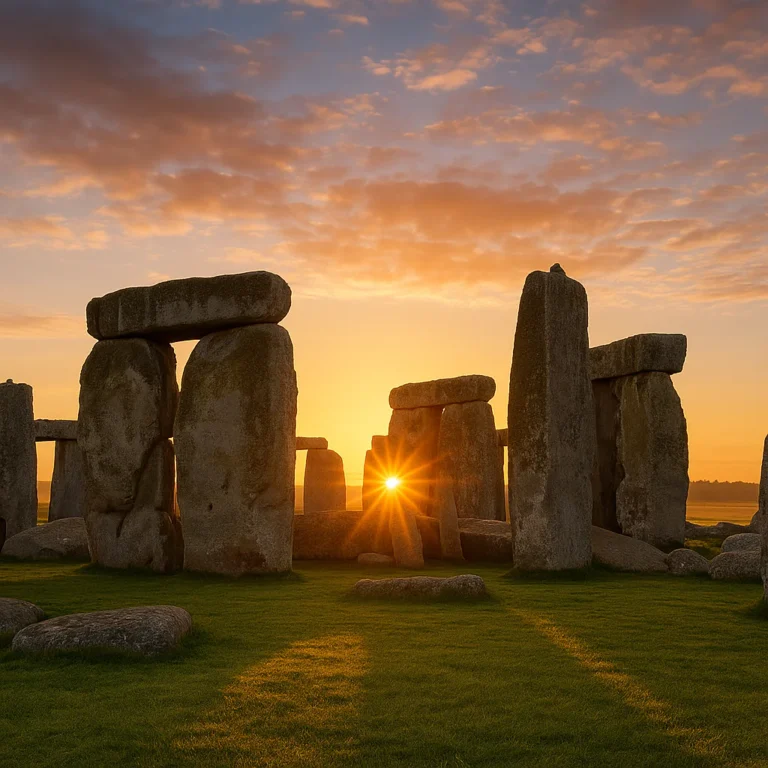
The monument’s most recognizable structure is the large sarsen circle, with horizontal lintels resting on upright stones. Inside it, the tall trilithons—pairs of uprights supporting a lintel—form a horseshoe arrangement.
This was sophisticated stonework. Builders shaped the sarsens, used mortise-and-tenon joints between uprights and lintels, and employed projecting tongue-and-grove joints to help keep lintels aligned. These carpentry-like details reveal deliberate design and skilled workmanship, not rough stones simply stacked until they behaved (English Heritage).
The sarsen structure was not necessarily the project’s final word. Stonehenge was altered, rearranged, and used across generations. The stones we see today are a remarkable surviving arrangement, but the ancient monument was a changing place.
🔍 12 Theories About How Stonehenge Was Built
These explanations are not all competing answers. Some describe transport, others describe lifting, and several could have been used at different stages. A prehistoric crew might have hauled a stone on a sledge, levered it upright, and then used a timber platform to set its lintel. Ancient engineering, like modern construction, rarely depends one trick.
| Method | What it might explain | Main limitation |
|---|---|---|
| Timber sledges and tracks | Moving heavy stones over land | Rough, wet, wooded terrain would be difficult |
| Boats, rafts, or coastal transport | Part of the bluestones’ long journey | The exact route and feasibility remain debated |
| Glacial transport | Natural movement of some Welsh stones | Whether ice reached Salisbury Plain is uncertain |
| Ramps, levers, ropes, and timber frames | Raising stones into pits and positioning lintels | No single method has been proven as the method |
| Organized communal labor | Coordinating transport and construction | Workforce size and labor estimates vary widely |
1. Timber sledges and rollers moved the stones overland
A wooden sledge pulled across a prepared track is one of the most familiar explanations for moving large stones. Builders could place a stone on a timber frame, haul it with ropes, and add logs or track sections as the load advanced. It is simple to picture—and then you remember that Salisbury Plain is not a polished warehouse floor.
Why it is plausible:
- Neolithic people had timber, rope-making skills, and experience moving heavy objects.
- Sledges distribute a stone’s weight over a larger surface.
- A prepared track can reduce drag compared with pulling a boulder directly over soil.
- The method can be adapted: rollers on smoother ground, a sledge on rougher or softer ground.
Why it is difficult to prove:
- Timber rarely survives for thousands of years in the local conditions.
- The route from Wales crossed challenging ground, and transporting timber equipment itself required work.
- Experimental reconstructions show what people can do, not necessarily what prehistoric builders did.
A useful comparison comes from a 1997 experiment reported in the New Scientist: around 130 people struggled to move a 40-ton concrete replica until they coordinated their pulling and levering. That demonstrates the value of teamwork, but a modern trial is not a time machine. Its materials, surface, and participants do not perfectly reproduce Neolithic conditions (New Scientist).
2. Rafts and boats carried bluestones by water
A long-standing proposal is that people moved at least some Welsh bluestones by water, using rafts or boats along rivers and the coast, then hauling them overland to Stonehenge. Water can support much of a cargo’s weight, making a boat route attractive in theory.
But attractive on paper is not the same as easy in the Bristol Channel. Builders would have needed to manage tides, currents, loading, landings, and the final journey inland. A frequently cited modern reenactment, the Millennium Stone Project, attempted to move a heavy stone by water; the stone sank after its sling failed. The failure does not prove ancient transport impossible, but it is a vivid reminder that a wet route comes with wet consequences.
Best balanced view: water transport may have formed part of a mixed route, but there is no definitive evidence that the bluestones were carried all the way by boat.
3. Glaciers transported the bluestones naturally
Some geologists have argued that glaciers could have carried stones from Wales and deposited them closer to Stonehenge as glacial erratics. If so, prehistoric people may have moved the stones only a shorter distance from a natural deposit.
The difficulty is geographical. Evidence for ice movement in parts of Wales and southwest Britain does not automatically show that a glacier carried the relevant stones to Salisbury Plain. Researchers disagree over how far ice extended and whether the pattern of stones at Stonehenge fits natural deposition or human selection.
The discovery and study of Neolithic quarry sites in Wales strengthens the case that people deliberately extracted at least some bluestones. It does not settle every question about every stone. A sound conclusion is therefore not “glaciers definitely did it” or “glaciers definitely had no role,” but “the specific route remains debated.”
4. Workers used levers to raise the standing stones
A lever turns a manageable force into a useful movement. By lifting one edge of a stone a little at a time and inserting wooden supports beneath it, workers could gradually raise it or shift it into position.
The appeal is obvious: levers are mechanically simple, and prehistoric builders could make them from timber. The challenge is controlling a massive stone safely. A small mistake with a multi-ton block is not a “whops”; it is a monument-shaped emergency.
Levering may have been part of the job, particularly for nudging stones, adjusting a sledge, or raising an upright in stages. It is unlikely to explain the entire process on its own.
5. Earth ramps helped lift stones into place
Builders may have packed earth, chalk, or rubble around a stonehole to form a ramp. A stone could be dragged or pushed up the incline, then eased into a prepared pit. After the stone was set upright, workers could remove the temporary ramp material.
For lintels, a raised earth platform could bring the horizontal stone close to the top of the uprights. Workers might then lever, slide, or roll it into place and clear the platform away.
Benefits: ramps spread effort across a gradual incline and leave behind little timber evidence.
Drawback: ramps can require enormous quantities of material, and archaeologists have not identified one single ramp system that explains every stone placement. The archaeological record may have been disturbed, but that uncertainty must not be mistaken for proof.
6. Timber A-frames and ropes tilted stones upright
A timber A-frame could act as a support or lifting structure. Ropes attached to the stone might help control its movement as the base was guided into a stonehole. Workers could then pack the hole with rubble and chalk to stabilize the upright.
This proposal relies on considerable timber and rope skills, both entirely plausible for prehistoric communities. But A-frames are a reconstruction hypothesis, not a confirmed Stonehenge blueprint. Timber frames decay, and the archaeological evidence does not preserve a complete lifting rig.
7. A pit-and-counterweight method raised the megaliths
In one proposed method, workers placed a stone beside a deep pit and used ropes, levers, and a counterweight to tilt it upright. The stone could be lowered into a prepared hole while people controlled its angle.
Retired construction worker Wally Wallington demonstrated that leverage and small supports can move surprisingly heavy objects. His demonstrations make a useful point: ancient builders did not need to lift a stone clean off the ground to move it. Small, repeated movements can add up.
Still, a demonstration with modern concrete and controlled conditions cannot establish that Stonehenge builders used precisely the same technique. It offers mechanical plausibility, not direct archaeological proof.
8. Wooden platforms supported the lintels
To place a lintel across two upright stones, builders may have built a timber platform, raised the lintel in stages, or used an earth ramp combined with levers. Once positioned, the lintel’s shaped joints could help it sit securely.
No surviving account tells us which combination was used. The safest explanation is that builders likely used temporary supports and incremental lifting, with the exact method varying according to the stone’s size, shape, and location.
9. Mortise-and-tenon joints locked the sarsen circle together
The sarsen lintels were shaped to fit over upright stones using mortise-and-tenon joints, a technique familiar from woodworking. Some lintels also have tongue-and-grove connections that helped link the horizontal stones around the circle.
This is one of the clearest signs of design and craft at Stonehenge. It also explains why the stones were not just hauled into rough positions: workers shaped and fitted them carefully, likely using stone hammers and repeated grinding or pecking.
10. Stone tools shaped the monument’s carefully fitted surfaces
The builders used hard stone tools to chip, pound, and smooth the sarsens. Archaeologists have found stone tools and evidence of shaping techniques at the monument. The regularity of some surfaces and joints suggests skilled labor, though shaping a stone by hand remained slow work.
A stone hammer is less cinematic than an alien laser. It is also much better supported by archaeological evidence.
11. Thousands of people organized the labor
Stonehenge required people to quarry, transport, shape, raise, and maintain stones, as well as feed and organize workers. That does not mean one enormous army worked continuously for centuries. Construction likely involved groups assembling for particular tasks, perhaps seasonally, with skills and responsibilities shared across communities.
Labor estimates vary dramatically depending on what researchers count: quarrying, toolmaking, track construction, stone shaping, transport, lifting, or years of maintenance. Estimates expressed in “man-hours” can look precise while resting on uncertain assumptions. The labor was unquestionably substantial; the exact headcount and schedule are not known.
12. Construction methods changed over Stonehenge’s long building history
Stonehenge’s different phases involved different materials and structures. Earthworks, timber features, bluestones, and sarsens would not all have been built with one identical technique.
That is why a single “how they built Stonehenge” answer can mislead. Builders might have used sledges for one move, water transport for another, and ramps or levers for raising stones. The most plausible explanation is a toolkit of methods, adapted over time.
🧭 Where Did Stonehenge’s Stones Come From?
Stonehenge’s stones came from more than one geological source. Their origins matter because the different distances create different transport questions: the sarsens traveled a relatively short route from the Marlborough Downs, while many bluestones came from much farther west.
| Stone type | Likely source | Approximate journey to Stonehenge | Why it matters |
|---|---|---|---|
| Sarsen | Marlborough Downs, Wiltshire | About 25 km (16 miles) | Large stones used for the outer circle and trilithons |
| Bluestones | Several Welsh source areas | More than 200 km (125 miles) straight-line distance from the Preseli region | Their long-distance movement remains one of the major puzzles |
| Altar Stone | Geological origin identified in Scotland in recent research | Hundreds of kilometres | Challenges earlier assumptions about all major stones coming from southern Britain |
Distances depend on the source point and whether one measures a straight line or a possible ancient route. The actual journey would have been longer than a map’s shortest line.
Sarsen stones from the Marlborough Downs
The massive sarsens are a form of hard sandstone, and geological studies have linked most of Stonehenge’s sarsens to the West Woods area near the Marlborough Downs. The stones’ size and weight made transport a formidable task, but the source was far closer than Wales.
In 2020, researchers used geochemical analysis to identify the likely source of many sarsens. The study’s results, published in Science Advances, provide a strong geological link, though they do not tell us exactly which path the builders followed (Science Advances).
Bluestones from the Preseli Hills in Wales
“Bluestone” is a convenient umbrella term for several kinds of stone, not a single rock type. Geological research links important groups to sources in and around the Preseli Hills in Pembrokeshire. Other stones may have come from different Welsh locations.
The quarry evidence at Craig Rhos-y-felin and Carn Goedog has sharpened the discussion. Archaeologists have found features interpreted as quarrying activity, including stone-working evidence and natural ledges that could have helped release blocks. Researchers disagree about how much this proves about the stones’ later journeys: identifying a quarry is not the same as tracing every stone from quarry to monument.
The Altar Stone and its possible Scottish origins
A 2024 study in Nature reported that the Altar Stone—the large, low-lying stone within Stonehenge—has a geological origin in northeast Scotland, not Wales. The result adds a striking long-distance transport question to an already complicated story (Nature, “A Scottish provenance for the Altar Stone of Stonehenge”).
This finding should be stated carefully: it identifies a likely geological source, but does not reveal the precise transport route or method. It also reminds us that Stonehenge’s builders may have drawn stones from a wide geographic network rather than one quarry region.
🛠️ How Neolithic Builders Shaped and Stood the Stones
Stonehenge’s construction involved several distinct jobs: selecting stone, extracting or preparing it, transporting it, shaping it, preparing foundations, and raising it. Each step presented different challenges. Here is a plausible sequence, based on archaeological evidence and engineering experiments—not a claim that every stone followed precisely the same recipe.
Stone axes, hammerstones, and other prehistoric tools
Builders could use hard hammerstones to chip away at softer surfaces and shape edges. Smaller tools could refine joints and surfaces. Timber tools, ropes, and wooden wedges may also have helped with quarrying and handling.
A likely toolkit included:
- Hammerstones for pecking and rough shaping.
- Stone axes and adzes for woodworking.
- Timber wedges and levers for shifting or splitting material.
- Ropes and straps for hauling and controlling loads.
- Sledges or tracks for moving stones over ground.
Not every tool used has been recovered. Organic materials decay, while stone tools survive more readily. That creates an archaeological bias: the record may show us the hammerstone more clearly than the rope that did part of the heavy lifting.
Diging postholes, pits, and foundations
For an upright stone, workers first needed to prepare a hole deep and wide enough to receive its base. They may have used stone tools, wooden shovels, antler picks, and baskets to remove soil and chalk. A stone could be lowered or tilted into the hole, then secured with packing material.
A simplified sequence might look like this:
- Mark the position using stakes, ropes, or sightlines.
- Dig a stonehole large enough for the stone’s base and planned angle.
- Bring the stone to the edge on a sledge, track, or rollers.
- Control the descent with ropes and levers as the stone enters the hole.
- Raise it toward vertical using leverage, ramps, or a timber support system.
- Pack and stabilize the base with chalk, rubble, or compacted earth.
- Check alignment before removing temporary supports.
This sequence explains how a stone might stand without a crane, but its details remain hypothetical. Archaeologists can study the stoneholes and packing deposits; they cannot watch the original crew at work.
Lifting the stones and fitting the lintels
Once the uprights were standing, placing lintels required precise control. Builders may have used a raised earthen platform or timber scaffolding to bring each lintel close to the top of its supports. Ropes and levers could then move it into position.
The fit of the joints matters here. Mortise-and-tenon connections would help the lintel sit securely on its uprights, while the surrounding ring’s joints could help keep the circle aligned. The builders’ achievement was not merely vertical lifting. It was lifting, fitting, and stabilizing heavy stone in a carefully planned arrangement.
🚚 How Were Stonehenge’s Stones Transported?
The transport problem depends on which stones we mean. The sarsens likely traveled a shorter overland route from Wiltshire. The bluestones present a far longer journey from Wales, and the Altar Stone’s Scottish origin adds another possible long-distance connection.
The overland route from the Marlborough Downs
The sarsens may have been hauled from the Marlborough Downs overland. A timber sledge on a prepared track is plausible, but the route would have crossed uneven ground and may have required clearing or adapting sections of the landscape.
A possible overland transport sequence:
- Select a suitable stone close to an accessible outcrop.
- Prepare the stone enough to make it safer or easier to move.
- Position it on a timber sledge or supporting frame.
- Lay track or rollers where ground conditions demanded them.
- Use ropes and coordinated teams to pull and steer.
- Pause to reinforce the route, replace damaged timbers, or adjust the load.
- Move the stone to the monument and transfer it to a lifting system.
This is a practical reconstruction, not a documented itinerary. The route, track design, and number of people remain uncertain.
The debated journey from Wales to Salisbury Plain
For the bluestones, researchers have considered several possibilities:
- Overland hauling on sledges, rollers, or prepared tracks.
- A mixed route involving land and water.
- River and coastal transport using rafts or boats.
- Natural movement by glaciers, followed by human relocation.
- Movement from an earlier Welsh monument, rather than directly from quarry to Stonehenge.
These ideas are not equally supported, and some could be combined. Quarry research supports human extraction of at least some stones; it does not by itself prove that people hauled every stone all the way to Wiltshire. A proposed movement from Waun Mawn is especially intriguing, but archaeologists continue to test how strong the connection is.
The first video’s account presents a compelling narrative of people moving a Welsh stone circle to Salisbury Plain. It is a useful interpretation, but the story should be read as a theory built from archaeological clues, not as a fully established fact. You can revisit that perspective at the featured video.
What experiments with sledges and replicas can tell us
Experiments help test what is mechanically possible. Researchers and volunteers have tried moving heavy stones with timber tracks, sledges, rollers, ropes, and levers. Such trials demonstrate that organized people can move loads without modern machinery, but results depend on the stone, ground, weather, materials, and team coordination.
| Experimental approach | What it shows | What it cannot prove |
|---|---|---|
| Sledge and timber track | Heavy stones can be moved with coordinated pulling | That Stonehenge builders used the same track |
| Rollers | Rolling can reduce effort on some surfaces | That rollers worked well on every terrain |
| Levers and small supports | Incremental movement can shift large loads | The exact ancient lifting sequence |
| Boat or raft trials | Water transport is possible in principle | That a particular ancient route was used |
| Concrete replicas | A team can test basic mechanics | How prehistoric timber, ropes, and soil behaved |
Experiments are most useful when treated as engineering tests, not historical proof. The failed Millennium Stone Project trial, for example, exposed risks in a modern transport attempt. It did not show that prehistoric mariners lacked the skill to try a different design.
👥 Who Built Stonehenge, and How Many People Did It Take?
Stonehenge was built by communities, not by one named architect whose biography was forgotten. The people who raised the stones belonged to societies with practical expertise in farming, woodworking, stoneworking, navigation, and ceremonial life.
Neolithic and Bronze Age communities at work
The monument developed over a long period, so different generations contributed to it. Builders may have included quarry workers, woodworkers, stone shapers, haulers, planners, cooks, and people responsible for maintaining gathering places and routes.
The word “builder” can hide a lot of labor. A person who made rope, prepared food, cut timber, or dug a track was part of the construction effort, even if they never touched a sarsen.
Food, planning, skills, and social organization
Large projects require more than muscle. People needed to decide where stones would go, coordinate labor, manage tools, supply food, and resolve practical problems. Seasonal gatherings could have helped communities pool workers and resources.
Archaeological evidence from the wider Stonehenge landscape, including settlements and feasting remains at places such as Durrington Walls, suggests that large gatherings were part of the region’s prehistoric life. That does not mean every worker lived at the monument year-round. It points instead to a landscape capable of hosting people and ceremonies (English Heritage).
What archaeology reveals about builders’ lives
Human remains, tools, animal bones, and settlement evidence offer glimpses of the people connected to Stonehenge. Isotope studies can reveal where some individuals spent parts of their lives, while burial practices and grave goods show that people treated the area as socially and ceremonially significant.
The evidence does not provide a full census or a neat list of job titles. It does show that Stonehenge belonged to a wider world of movement and exchange. People, ideas, and materials traveled across prehistoric Britain—and the stones may have been part of that network.
🧪 What Archaeological Evidence Supports Each Construction Theory?
A useful way to judge a construction theory is to ask three questions:
- Does it fit the physical evidence?
- Does it fit what we know about the date and landscape?
- Does it explain the evidence better than competing ideas?
| Evidence | What it supports | What remains uncertain |
|---|---|---|
| Stoneholes and earthworks | Several phases of building and modification | The precise lifting method |
| Geological analysis | Multiple source regions for the stones | The exact transport route |
| Welsh quarry sites | Human extraction of some bluestones | Whether stones moved directly from quarry to Stonehenge |
| Shaped stone joints | Skilled planning and fitting | The temporary lifting structures used |
| Human remains and burial context | Funerary and ceremonial significance | Whether burial was the monument’s only purpose |
| Experimental reconstructions | Mechanical feasibility of methods | Which methods ancient builders actually chose |
Stonehenge’s postholes, pits, and earthworks
The monument’s ditches, banks, pits, and stoneholes record construction and use over time. The Aubrey Holes, for example, are associated with cremated remains and an early phase of the enclosure. The positions and relationships of features help archaeologists build a chronology.
A pit can tell researchers where something stood or was removed, but it cannot always tell them exactly how it got there. That is where archaeological interpretation begins—and where confident-sounding claims should stay modest.
Tool marks and engineering details
The shaped surfaces and joints of the sarsens are evidence of deliberate working. The mortise-and-tenon joints are especially telling: builders designed stone surfaces to interlock rather than relying solely on weight and friction.
The same evidence does not reveal the full construction apparatus. No archaeologist has excavated a complete A-frame, rope rig, and lifting plan. Timber and fibre decay, and later disturbance can erase traces.
Ancient DNA, isotopes, and the people connected to the monument
Isotope research can provide clues about where people grew up or lived, while ancient DNA can help investigate population history. These methods are valuable, but they do not let researchers label a person “Stonehenge builder” with certainty.
A person buried near the monument could have been a visitor, a local resident, a worker, or someone with a ceremonial role. Location is evidence, not a job description.
Experiments, reconstructions, and their limits
Modern trials can test whether a proposed method is physically workable. For example, they can measure how many people are needed to pull a replica across a particular surface, or whether a lever can raise a block in stages.
But an experiment cannot prove that the method was used at Stonehenge unless archaeological evidence independently supports it. Concrete is not sarsen; a modern rope is not necessarily a prehistoric one; and a prepared field is not the same as a Neolithic route. Experiments are valuable when they narrow possibilities, not when they pretend to settle every question.
❌ Stonehenge Construction Myths: Aliens, Druids, and Other Tall Tales
Stonehenge has attracted stories about giants, wizards, Druids, the Devil, and extraterestrials. Some are fascinating folklore; others are modern claims that underestimate prehistoric people. We can enjoy the stories while separating them from archaeological evidence.
Did aliens build Stonehenge?
There is no credible archaeological evidence that aliens built Stonehenge or taught its builders how to move stones. The idea became popular in modern “ancient astronaut” writing, often based on the assumption that prehistoric people could not have managed complex engineering.
That assumption is the weak link. Archaeology documents human quarrying, tool use, stone shaping, earthworks, and long-distance movement. A difficult engineering problem is not evidence of extraterestrial help.
Were the Druids responsible?
No. Stonehenge’s main building phases began thousands of years before the Druids known from later historical sources. The association became popular in the sevententh century, especially through antiquarians such as John Aubrey and William Stukeley, but the chronology does not support Druids as the original builders.
The Druid connection remains culturally powerful, and modern Druids may gather at Stonehenge today. That modern relationship is real; it is simply different from claiming that ancient Druids constructed the monument. For more on how legends shape historical memory, see History Hidden’s Folklore and Legends and Mythology Stories collections.
Why medieval legends credited Merlin
In the twelfth century, Geoffrey of Monmouth told a story in which Merlin transported the stones from Ireland to Britain. Later versions added giants and magical elements. These are medieval legends, not eyewitness accounts of Neolithic construction.
The stories still tell us something important: people across the centuries found Stonehenge so extraordinary that they reached for extraordinary explanations. The monument inspired myth because its builders’ methods were no longer visible—not because magic is the strongest explanation.
🧩 Why Do Experts Still Disagree About Stonehenge’s Construction?
Experts disagree because the evidence is incomplete and several methods could have worked. A sledge, rollers, levers, and ramps are not mutually exclusive. The central challenge is matching a plausible engineering method to the archaeological record.
Evidence that has been lost or disturbed
Wood, rope, and plant-fibre materials decay. Tracks can disappear, soils can shift, and later digging can disturb older features. Stonehenge has also been excavated and restored over the past few centuries, meaning archaeologists must consider how modern interventions affect what survives.
What remains—stone, chalk, pits, tools, and burials—is only part of the original picture. The missing evidence is not permission to invent any explanation we like; it is a reason to compare theories carefully.
New discoveries that can reshape old theories
Geochemical analysis has refined ideas about the stones’ origins. Quarry excavations have added evidence for human extraction in Wales. Research on the Altar Stone’s Scottish origin has challenged older assumptions about where all major stones came from.
Each new discovery can change one part of the story without overturning everything else. A source identified in Scotland does not automatically explain how the stone arrived in Wiltshire. A quarry discovered in Wales does not prove every bluestone came from it. Archaeology advances by updating the picture piece by piece.
The strongest explanations—and the biggest open questions
The most convincing overall explanation is a combination of human techniques: stone extraction, timber transport systems, ropes, coordinated teams, leverage, prepared pits, ramps, and careful stone shaping.
The main open questions include:
- Which exact routes did the stones follow?
- Were any stones first part of a different monument?
- Did builders rely more on sledges, rollers, water transport, or a mix?
- How were lintels raised and placed with such precision?
- How many people took part in each major phase?
The methods remain uncertain. The builders’ ability does not.
🌞 Did Stonehenge’s Purpose Influence How It Was Built?
Construction and purpose are linked, but not in a simple one-to-one way. A monument’s alignments, burials, and setting can suggest what mattered to its builders without proving a single function.
Archaeologists have proposed that Stonehenge served as a ceremonial center, burial place, meeting ground, healing destination, astronomical marker, or memorial to ancestors. These theories can overlap. A place may host gatherings, honor the dead, and mark seasonal events at the same time.
Solar alignment and the summer solstice
Stonehenge is aligned with the solstitial axis: around the summer solstice, the Sun rises in the direction of the Heel Stone when viewed from the monument’s center; the winter-solstice sunset aligns in the opposite direction. The alignment is widely recognized and likely meaningful, though scholars debate whether it functioned as a calendar, a ritual marker, or both (English Heritage).
An alignment does not prove that Stonehenge was an “observatory” in the modern scientific sense. Nor does a possible calendar function explain every stone, burial, or surrounding monument. A strong interpretation leaves room for more than one purpose.
A ceremonial center, burial ground, or place of healing?
Stonehenge’s human remains and wider ritual landscape support a funerary and ceremonial interpretation. Researchers have also proposed that people may have traveled there seeking healing, pointing to burials of individuals with injuries or illnesses and to the possible special status of bluestones.
The healing idea is suggestive, but debated. An injured person buried at Stonehenge does not prove that the site was a hospital, and a stone’s perceived power cannot be measured archaeologically. The best-supported view is broader: Stonehenge was a ritually important place whose roles may have changed over time.
The wider Stonehenge landscape and nearby monuments
Stonehenge was part of a much larger prehistoric landscape that included avenues, earthworks, settlements, burial mounds, and other ceremonial sites. Nearby Durrington Walls and Woodhenge help researchers study how timber structures, gatherings, and stone monuments may have related to one another.
Archaeologist Mike Parker Pearson and other researchers have explored whether timber monuments were associated with the living and stone monuments with ancestors or the dead. This interpretation is influential, but it remains an argument based on landscape patterns, archaeology, and comparisons—not a belief directly recorded by Stonehenge’s builders. For background on the wider site, see the Stonehenge and Avebury World Heritage Site.
📍 Visiting Stonehenge: What You Can See for Yourself
Seeing the monument in person helps you appreciate its scale, setting, and relationship to the surrounding plain. It also reveals a limitation: you can stand beside the stones, but you cannot see the ropes, tracks, work camps, or planning that once made the construction possible.
For current visitor information, check the official English Heritage Stonehenge page.
The stones, earthworks, and visitor route
Visitors can view the stone circle from the marked route and explore the surrounding landscape. The visitor experience includes interpretive material about the monument’s construction, chronology, and archaeological discoveries. Access arrangements and special event guidance can change, so consult English Heritage before visiting.
A practical tip: take time to look beyond the biggest stones. The arrangement of the earthworks, the open landscape, and the distance between monuments all help explain why Stonehenge should be understood as part of a wider ceremonial landscape.
What the landscape can—and cannot—reveal
From the site, you can appreciate the monument’s alignment and dramatic setting. You cannot, from one visit alone, identify the original transport route or determine which lifting theory is correct. Those answers come from geology, excavation, dating, and careful comparison.
The view is still valuable. Stonehenge’s scale makes one fact unmistakable: building it required people to work together over time. The precise engineering remains debated; the collective effort is written into the monument itself.
❓ Frequently Asked Questions About Stonehenge’s Construction
How did prehistoric people transport the stones used to build Stonehenge?
The exact methods are unknown. Researchers consider wooden sledges, timber tracks, rollers, ropes, and, for some stones, possible water transport. The sarsens likely came from the Marlborough Downs, while many bluestones came from Wales. A mixed approach—different techniques for different stones and terrain—is plausible.
Why was Stonehenge built, according to the leading theories?
Leading interpretations include a ceremonial gathering place, a burial and ancestor monument, a site connected with seasonal or solar events, and possibly a healing destination. These ideas are not necessarily exclusive. The evidence supports ritual and funerary importance, but it does not establish one single purpose for every period of Stonehenge’s history.
Did ancient builders use wooden rollers to move Stonehenge’s stones?
They may have used rollers in some circumstances, but there is no definitive archaeological evidence that rollers were the universal method. Rollers work best on suitable, relatively firm ground and can be difficult to manage on rough or bogy terrain. Sledges and prepared tracks may have been more practical for some parts of a journey.
How were Stonehenge’s massive stones lifted into place?
Plausible methods include digging a stonehole, tilting the upright into it using ropes and levers, and packing the base with material. For lintels, builders may have used ramps, platforms, levers, or combinations of temporary supports. The joints and shaping show careful planning, but the exact lifting system has not been confirmed.
Were Stonehenge’s bluestones transported from Wales by land or by water?
Researchers disagree. Overland hauling, coastal or river transport, and mixed routes have all been proposed. Geological evidence links bluestones to Welsh sources, while quarry discoveries support human extraction of some stones. Neither the precise route nor the balance of land and water transport is settled.
What evidence suggests Stonehenge was built in several stages?
The monument includes earthworks, pits, stoneholes, and structures from different periods. Radiocarbon dating and the physical relationships between features show that the enclosure, bluestones, sarsen circle, and surrounding landscape did not all appear at once. Stonehenge developed through repeated construction and modification over centuries.
Could Stonehenge have been constructed as ancient astronomical observatory?
Its solstitial alignment is real and likely significant. But calling it an “astronomical observatory” can imply a modern scientific function that the evidence does not establish. Stonehenge may have marked seasonal events or embodied solar symbolism within ceremony, but its alignment alone cannot prove that astronomy was its sole purpose.