Support our educational content for free when you purchase through links on our site. Learn more
🗿 Stonehenge’s Secret: What the Stones Reveal


What is the secret behind the Stonehenge? The strongest answer is that it was a remarkable prehistoric ceremonial and burial monument, shaped over generations and aligned with the Sun—not a puzzle with one proven purpose. Its stones reveal impressive engineering and long-distance connections, but the builders left no written explanation of what it all meant.
Stonehenge wasn’t built in a single burst: its earliest major earthwork dates to around 300 BCE, and the monument was altered over centuries. Even the stones have far-travelling stories: many bluestones came from Wales, while research has traced the Altar Stone to north-east Scotland.
That’s where the mystery gets more interesting. The solstice alignment is clear, but whether Stonehenge was a sacred gathering place, a monument for ancestors, a seasonal observatory, or several things at once remains open to debate.
Key Takeaways
- Stonehenge had multiple construction phases and was used and reshaped over generations.
- Its exact purpose is unknown; evidence points to ceremonial and funerary roles, with possible seasonal and social uses.
- The stones came from far-flung sources, including Wales and, for the Altar Stone, north-east Scotland.
- The solstice alignment is real, but it doesn’t prove Stonehenge functioned as a precise calendar.
- Archaeology separates evidence from legend: Merlin and alien-builder stories are folklore, not supported explanations.
Table of Contents
- ⚡️ Quick Tips and Facts About Stonehenge
- 🗺️ Stonehenge at a Glance: Location, Layout, and Key Dates
- 🏺 The History of Stonehenge: From Neolithic Monument to World Heritage Site
- When was Stonehenge built?
- Who built Stonehenge?
- How has Stonehenge changed over time?
- 🪨 How Was Stonehenge Built? The Stones, Tools, and Engineering
- Where did the sarsen stones and bluestones come from?
- How were the stones transported to Salisbury Plain?
- How did prehistoric builders raise and shape the stones?
- 🌞 Why Was Stonehenge Built? The Leading Theories
- 1. A prehistoric temple for worship and ritual
- 2. An ancient solar calendar and observatory
- 3. A place for healing and pilgrimage
- 4. A monument for the dead and their ancestors
- 5. A gathering place for feasting and community
- 🌅 Stonehenge and the Summer and Winter Solstices
- How the stones align with the Sun
- Solstice celebrations: ancient customs and modern gatherings
- 🔍 What Archaeology Reveals About Stonehenge
- Human remains, burials, and cremation rituals
- Animal bones, feasting, and evidence of migration
- Stonehenge’s connection to the wider prehistoric landscape
- 🧩 Stonehenge Mysteries: What We Know and What Remains Unsolved
- Why were the bluestones brought from Wales?
- Was Stonehenge really a calendar?
- How did prehistoric people organize such a huge project?
- Did Merlin, aliens, or other legends explain Stonehenge?
- 📍 Visiting Stonehenge: What to Know Before You Go
- Where is Stonehenge, and how do you get there?
- Stonehenge visitor centre, facilities, and accessibility
- Can you touch or walk among the stones?
- Best time to visit and photography tips
- 🌿 Protecting Stonehenge: Conservation and Modern Challenges
- 🔗 Related Prehistoric Sites Near Stonehenge
- Avebury and its stone circle
- Woodhenge and Durrington Walls
- ✅ Conclusion
- 📚 Recommended Links
- ❓ FAQ
- 🔎 Reference Links
⚡️ Quick Tips and Facts About Stonehenge
The first hidden-history clue is that Stonehenge was not built in one burst. It developed over many centuries, and its builders left no written explanation. Our historians’ deeper look at Stonehenge construction mysteries explores why the stones’ origins and journey still spark debate.
| Quick fact | What the evidence tells us |
|---|---|
| Location | Salisbury Plain, Wiltshire, England |
| First major earthworks | Began around 300 BCE, according to English Heritage |
| Famous stone phases | The monument was altered and rebuilt over centuries; the familiar arrangement took shape during the late Neolithic and early Bronze Age |
| Main stone types | Large sarsen stones and smaller, varied bluestones |
| Key alignment | The monument’s axis relates to the summer-solstice sunrise and winter-solstice sunset |
| Written explanation from its builders? | None has been found |
| Best-supported answer to “What was its secret?” | It was a complex ceremonial and burial monument, used and reshaped over generations; its exact purpose remains uncertain |
Quick take: Stonehenge was not simply a stone calendar, a temple, or a tomb. It may have served several purposes at once, changing as communities changed. That layered answer is less tidy than ancient instruction manual—but considerably closer to the evidence.
✅ What we know: Archaeologists have studied its stones, earthworks, burials, nearby settlements, and celestial alignments.
❌ What we don’t know: The builders’ own name for the monument, their precise beliefs, or one definitive purpose.
🗺️ Stonehenge at a Glance: Location, Layout, and Key Dates
Stonehenge stands on Salisbury Plain, a broad chalk landscape in southern England. It is part of a much larger prehistoric setting, not an isolated ring dropped into a field. Nearby monuments, burial mounds, ancient routes, and ceremonial spaces help explain why this particular patch of countryside mattered.
What does Stonehenge look like?
The monument’s best-known features are:
- An outer circle of upright sarsen stones, many topped with horizontal lintels.
- An inner arrangement of bluestones.
- A horseshoe of large sarsen pairs topped by lintels, called trilithons.
- An earthwork enclosure, including a circular bank and ditch.
- The Heel Stone, positioned outside the main circle along the monument’s principal axis.
| Feature | Material or form | Why it matters |
|---|---|---|
| Sarsen circle | Large sandstone blocks | Its carefully shaped lintels and stone joints show sophisticated planning |
| Inner bluestones | Several kinds of rock | Many are linked to sources in Wales, though the route they took remains debated |
| Trilithons | Two uprights supporting a lintel | Create the monument’s imposing inner horseshoe |
| Heel Stone | Large standing stone outside the circle | Frames the solstitial alignment when viewed from within |
| Bank and ditch | Earthwork enclosure | Among the earliest monumental features of the site |
A note on dates: you may see different construction dates in popular accounts because Stonehenge is a sequence of building phases, not a single project. The earliest earthwork dates to around 300 BCE; later generations moved, added, or rearranged stones. English Heritage’s site history is a useful guide to that long timeline.
🏺 The History of Stonehenge: From Neolithic Monument to World Heritage Site

Stonehenge’s story begins before the famous stone circle. For thousands of years, people gathered, buried their dead, and built monuments across the surrounding landscape. The site’s later stonework joined an already meaningful place.
When was Stonehenge built?
There was no single “Stonehenge construction day.” Archaeologists divide its development into phases, based on excavations, radiocarbon dating, and the relationships between features.
| Broad phase | What happened |
|---|---|
| Early activity | People used the area before the main stone monument took shape |
| Around 300 BCE | A circular earthwork enclosure was constructed |
| Late Neolithic period | Bluestones and major stone settings were brought into the monument |
| Later prehistoric centuries | Stones were rearranged, and the site continued to be used |
| Modern era | Antiquarians, archaeologists, conservationists, and visitors reshaped how Stonehenge is understood and protected |
The familiar layout emerged gradually. That matters because it complicates any single-purpose explanation: a monument used for centuries could acquire new roles, meanings, and rituals.
Who built Stonehenge?
The builders were prehistoric communities in Britain, not a named king, druid, Roman engineer, or mysterious visiting civilization. Archaeology has not identified one master builder. It points instead to people capable of organizing labor, moving materials, shaping stone, and maintaining traditions across generations.
The people who built Stonehenge left no written records. We therefore infer their society from evidence such as tools, animal remains, human burials, and nearby settlements. The absence of writing does not mean the builders lacked sophisticated knowledge; the monument itself argues otherwise.
How has Stonehenge changed over time?
Stones were added, shifted, and removed or lost. The monument we see today is not a frozen snapshot of one prehistoric moment. It is a partial survivor of a changing place.
Early antiquarians also influenced modern ideas about Stonehenge. The first video discussed in this article points to figures such as William Stukeley, whose observations helped popularize the solstice-alignment theory. You can revisit that perspective through the article’s featured video. His work was influential, but modern archaeological evidence—not a single antiquarian interpretation—must carry the final word.
🪨 How Was Stonehenge Built? The Stones, Tools, and Engineering
Stonehenge’s builders had no cranes, steel cables, or lorries. They did have planning, practical engineering, skilled labor, and time. The surviving monument offers clues to how they shaped and joined its stones, but the full construction process remains a subject of research.
Where did the sarsen stones and bluestones come from?
The large outer stones are sarsens, a hard sandstone. Research has traced many of them to the Marlborough Downs, roughly 25 kilometres (about 15 miles) north of Stonehenge. The smaller stones grouped under the name bluestones include several rock types; many are associated with the Preseli region of west Wales.
The Altar Stone adds another twist. A study published in Nature traced its sandstone origin to north-east Scotland, far beyond the commonly discussed Welsh sources. That discovery demonstrates how the monument’s material story is still developing, rather than proving exactly how the stone travelled. See the research summary from the University of Aberdeen and the original Nature study.
| Stone group | Approximate origin | What remains uncertain |
|---|---|---|
| Sarsens | Marlborough Downs area | The precise route and techniques used to bring them to the site |
| Many bluestones | Preseli region, west Wales | Whether people moved them entirely by human effort, and by what route |
| Altar Stone | North-east Scotland, according to recent research | Its transport route, timing, and the exact social meaning of its journey |
How were the stones transported to Salisbury Plain?
The long-distance movement of the bluestones is one of Stonehenge’s great puzzles. Researchers have proposed routes involving human transport over land, movement by water, or a combination. A competing possibility is that glacial ice carried some stones naturally—but researchers disagree about how well that proposal fits the geological and archaeological evidence.
Here’s the careful version: the stones’ geological origins are better established than their precise travel story.
A plausible human-transport scenario might involve:
- Selecting and detaching stone from an outcrop using available tools and knowledge.
- Preparing the route, perhaps using sledges, rollers, ropes, and teams of people.
- Moving the stones in stages, with pauses at camps or assembly points.
- Using waterways where possible, if the landscape and route allowed it.
- Hauling the stones to the monument, then raising them into place.
That is a reconstruction, not a documented eyewitness account. Large-scale engineering leaves room for multiple methods, and different stones may have travelled differently.
How did prehistoric builders raise and shape the stones?
Stonehenge’s sarsens show that builders shaped blocks with care. The lintels were joined to upright stones using mortise-and-tenon joints, while the horizontal stones were also fitted with tongue-like joints. These woodworking-style techniques helped lock the stones together.
A proposed lifting sequence looks something like this:
- Dig a sloping pit beside the stone’s intended position.
- Drag the stone into the pit, guiding its lower end toward the base.
- Raise the upper end with ropes, levers, and coordinated pulling.
- Pack the hole with stones and rubble to secure the upright.
- Lift lintels into place, perhaps by building an earth or timber ramp and raising them incrementally.
- Shape and fit joints so the upper stones sat securely.
The method is reconstructed from the monument and experimental archaeology; it should not be mistaken for a confirmed step-by-step ancient blueprint. Still, the result is remarkable: the stones were not merely stacked; they were fitted into an engineered structure. English Heritage describes Stonehenge as “the most architecturally sophisticated surviving stone circle in the world” in its history and stories guide.
🌞 Why Was Stonehenge Built? The Leading Theories
The honest answer to “What is the secret behind Stonehenge?” is that we cannot confidently assign it one original purpose. The monument may have brought together ritual, burial, seasonal observation, healing beliefs, and community gatherings. The theories below are not equally proven, and they need not be mutually exclusive.
1. A prehistoric temple for worship and ritual
Stonehenge’s formal layout, solstitial axis, and place within a wider ceremonial landscape support the idea that it was a sacred or ritual site. But “temple” is a modern label. We cannot know precisely what the builders believed or whether their rituals resembled anything familiar today.
Some researchers interpret the monument as a place tied to ancestors. Archaeologist Tim Darvill has described it as “a kind of spirit home to the ancestors,” as quoted in National Geographic’s overview. That is a compelling interpretation—not an inscription left by Stonehenge’s builders.
2. An ancient solar calendar and observatory
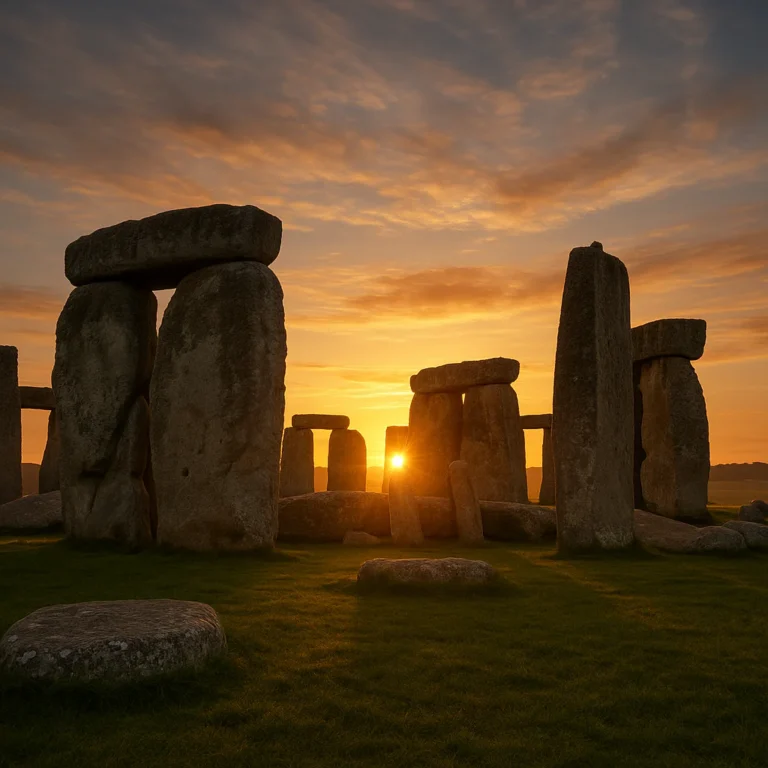
Stonehenge’s principal axis aligns with the summer-solstice sunrise and winter-solstice sunset. This makes careful observation of the Sun a strong part of the monument’s story. English Heritage explains the alignment in its Stonehenge history guide.
But an alignment does not automatically make Stonehenge a “calendar” in the modern sense. It shows that the builders designed or used the monument in relation to the Sun’s changing position. Whether they used it to mark dates, organize ceremonies, or express a cosmology remains open.
3. A place for healing and pilgrimage
A healing-site theory focuses on the effort involved in bringing bluestones from Wales. If people believed the stones had special properties, the monument could have attracted visitors seeking help or participating in healing rituals.
That interpretation is intriguing, but distance alone cannot prove a healing function. The stones may have mattered for other reasons: their appearance, their source, inherited traditions, or the symbolic value of connecting distant communities. National Geographic discusses this “prehistoric Lourdes” hypothesis while presenting it as a theory, not a settled fact (National Geographic).
4. A monument for the dead and their ancestors
Cremated human remains found at Stonehenge show that the monument had funerary connections. Burials do not prove that the entire site was a cemetery, but they do make it difficult to treat death and ancestry as side issues.
One interpretation is that Stonehenge connected the living with the dead, perhaps as part of a ceremonial route through the wider landscape. The monument may have given physical form to relationships among families, communities, and ancestors—an idea that fits the burial evidence without claiming to decode beliefs we cannot directly access.
5. A gathering place for feasting and community
Nearby Durrington Walls provides evidence of a substantial prehistoric settlement and large-scale feasting. Archaeologists have found animal remains that point to people gathering and eating together. This raises a useful possibility: Stonehenge may have been part of a seasonal social landscape where ceremonies, meals, movement, and remembrance overlapped.
The answer may not be “religion or community.” In many societies, the sacred and the social are not separate boxes. A gathering could be a feast, a ritual, a political event, and an act of remembrance all at once.
🌅 Stonehenge and the Summer and Winter Solstices
The Sun is the clearest celestial feature of Stonehenge’s design. The monument’s axis points toward the summer-solstice sunrise one end and the winter-solstice sunset on the other. That alignment is powerful evidence of intentional orientation, though it does not reveal exactly what the builders thought it meant.
How the stones align with the Sun
At midsummer, the Sun rises in the direction of the Heel Stone when viewed from the monument’s centre. At midwinter, the setting Sun appears along the opposite direction. The visual effect depends on where you stand, the horizon, weather, and the modern condition of the stones.
| Event | Solar direction | What the alignment may have meant |
|---|---|---|
| Summer solstice | Sunrise toward the Heel Stone | A seasonal marker, ceremonial focus, or expression of solar symbolism |
| Winter solstice | Sunset along the opposing axis | A counterpart moment that may have held equal or greater significance |
| Other days of the year | Sun rises and sets elsewhere | The monument’s axis remains a reference point, but not a day-by-day clock |
Solstice celebrations: ancient customs and modern gatherings
People still gather at Stonehenge for the solstices. Modern celebrations are not direct proof that today’s customs reproduce prehistoric rites. They do show that the alignment continues to inspire people across different traditions.
The site is managed by English Heritage, and access arrangements for solstice events can differ from ordinary visits. Check the official Stonehenge visitor information before making plans. And please follow site guidance: a monument that has survived millennia deserves more than a souvenir-sized chip.
🔍 What Archaeology Reveals About Stonehenge
Archaeology does not hand us a neat ancient biography. It gives us fragments: bones, tools, earthworks, stones, and traces of activity. Put together carefully, they reveal a monument with a longer and more varied life than its postcard silhouette suggests.
Human remains, burials, and cremation rituals
Cremated human remains have been found at Stonehenge, making it one of the prehistoric sites with clear funerary evidence. These remains suggest that people were buried or commemorated there, particularly during earlier phases of the monument’s history.
They do not establish that every stone was erected as a grave marker, nor do they tell us the exact ceremonies involved. The strongest conclusion is more modest: death and commemoration formed part of Stonehenge’s use.
Animal bones, feasting, and evidence of migration
Animal remains from the wider landscape help researchers reconstruct how people gathered and ate. Archaeological studies of Durrington Walls have identified evidence of major feasting, including pigs and cattle. Analyses of animal teeth have also helped investigate where animals were raised before they arrived at the site.
These discoveries suggest that Stonehenge’s story reaches beyond the stone circle itself. People, livestock, food, and materials moved across the landscape. Some visitors may have travelled long distances, though the scale and character of those journeys remain debated.
Stonehenge’s connection to the wider prehistoric landscape
Stonehenge is part of a wider group of prehistoric monuments and settlements, including Avebury, Durrington Walls, and Woodhenge. Their relationships suggest that ancient people used the landscape as a network of meaningful places, rather than treating each monument as a stand-alone attraction.
Stonehenge and Avebury were inscribed as a UNESCO World Heritage Site in 1986. UNESCO’s Stonehenge, Avebury and Associated Sites entry describes the area’s exceptional prehistoric monuments and their landscape setting.
🧩 Stonehenge Mysteries: What We Know and What Remains Unsolved
Stonehenge’s mystery is real—but it is not evidence for every dramatic theory ever attached to it. Archaeologists distinguish between what measurements and excavations support and what later storytellers or modern speculators have imagined.
| Question | Best-supported answer | What remains uncertain |
|---|---|---|
| Who built it? | Prehistoric communities in Britain | The names, identities, and exact organization of the builders |
| Why was it built? | Likely multiple ceremonial and funerary purposes | The original meaning and how uses changed |
| How did stones arrive? | Geological sources can be identified for several stones | Exact routes and transport methods |
| Was it aligned with the Sun? | Yes, its main axis relates to the solstices | How builders interpreted or used that alignment |
| Did one group build it? | Construction unfolded in phases | How labor was organized across generations |
Why were the bluestones brought from Wales?
Many bluestones have been linked to the Preseli region of Wales, hundreds of kilometres from Stonehenge by modern road distance. Their presence suggests that the source mattered—or that people considered the stones worth transporting.
Possible explanations include:
- The stones carried cultural or ancestral meaning.
- Their source connected communities across regions.
- Their appearance or physical properties made them desirable.
- People believed the stones had healing or spiritual qualities.
- The stones were incorporated into an established tradition.
No single explanation has been proven. The recent Scottish origin identified for the Altar Stone adds another dimension: Stonehenge’s long-distance connections may have reached farther than older accounts assumed. It does not, by itself, tell us why that stone was chosen or how it travelled.
Was Stonehenge really a calendar?
Stonehenge’s solar alignment is well supported. Calling it a calendar, however, can imply more precision or everyday timekeeping than the evidence demonstrates.
A balanced interpretation is that the monument helped mark or give meaning to important points in the solar year. It may have supported ceremonies scheduled around seasonal turning points. That is not the same as proving it tracked every day or functioned like a modern calendar.
How did prehistoric people organize such a huge project?
Moving and raising heavy stones required coordination. People needed to acquire materials, prepare routes, provide food, manage labor, and maintain skills. Estimates of the total labor vary because they depend on assumptions about stone weight, transport methods, work rates, and how much of the project is included.
Rather than treating Stonehenge as a single construction job, it is more plausible to imagine repeated efforts across generations. The monument’s phases allowed knowledge and social commitment to accumulate over time.
Did Merlin, aliens, or other legends explain Stonehenge?
Medieval stories credit the wizard Merlin with moving stones from Ireland, while other legends invoke giants. Modern speculation has proposed aliens or other supernatural builders. These accounts can be fascinating folklore, but they are not supported by archaeological evidence.
The Merlin story belongs to the history of how later people made sense of ancient monument whose builders were long gone. Explore related material in History Hidden’s Folklore and Legends and Mythology Stories categories. The legends tell us a great deal about later imaginations—and not reliable engineering details about Neolithic Britain.
📍 Visiting Stonehenge: What to Know Before You Go
A visit can be rewarding, but Stonehenge is also a protected archaeological site. The visitor experience generally combines the monument with an interpretation centre and a shuttle or walk to the stones. Check the official site before you travel, especially for opening arrangements, access, and special events.
Where is Stonehenge, and how do you get there?
Stonehenge is near Amesbury in Wiltshire, around 13 kilometres (8 miles) north of Salisbury. Visitors commonly arrive by car, tour, or public transport connections from nearby towns. For current directions and travel guidance, consult English Heritage’s visitor page.
Stonehenge visitor centre, facilities, and accessibility
The visitor centre includes exhibitions and information that help place the stones in their archaeological context. Facilities and accessible routes can change, so review English Heritage’s accessibility information before your visit.
Useful planning tips:
- Allow time for the visitor centre, not just the stone circle.
- Wear shoes suited to open, sometimes muddy ground.
- Bring weather-appropriate clothing; Salisbury Plain is exposed.
- Check current transport, shuttle, and accessibility arrangements.
- Follow staff instructions and barriers to protect the monument.
Can you touch or walk among the stones?
Ordinary visits usually follow a managed route around the stone circle rather than allowing visitors to wander freely among the stones. Special access arrangements may apply at certain times, including some solstice events. Rules can change, so verify them with English Heritage.
The restrictions are not there to spoil the atmosphere. They help protect fragile archaeology and the stones themselves from cumulative wear.
Best time to visit and photography tips
For fewer crowds, consider quieter visiting times outside peak holiday periods, while checking the official calendar for seasonal changes. Sunrise and sunset can create dramatic light, but weather and access conditions are beyond anyone’s control—Stonehenge is ancient, not a studio with a lighting crew.
Photography tips:
- Use the landscape to show the monument’s scale and setting.
- Avoid blocking paths while composing a shot.
- Respect any limits on tripods or equipment.
- For solstice photography, check access rules and arrive prepared for crowds and changing weather.
🌿 Protecting Stonehenge: Conservation and Modern Challenges
Stonehenge is a World Heritage site, an archaeological archive, and a living place of cultural meaning. Protecting it means balancing public access, conservation, research, local communities, and the spiritual significance it holds for some visitors.
Challenges include:
- Erosion and wear from weather and visitor pressure.
- Traffic and development affecting the wider landscape.
- Climate and environmental change that can alter ground conditions.
- Balancing access with conservation, especially during major gatherings.
- Competing interpretations of the site’s heritage and contemporary use.
UNESCO’s World Heritage profile places Stonehenge in its broader landscape context. Conservation decisions are not merely about preserving impressive stones; they also protect the archaeological evidence around and beneath them—the quieter clues that may answer tomorrow’s questions.